How to Get Free Traffic for Affiliate Marketing Without Trying Every Traffic Source

Getting free traffic for affiliate marketing can feel overwhelming when you're just starting out.

One person recommends blogging. Another insists that social media is the fastest way to attract visitors. Someone else suggests YouTube, online communities, or publishing content across several platforms every day.

Before long, you're spending more time researching traffic methods than actually building traffic.

Here's something worth understanding: you don't need to use every free traffic source to get started with affiliate marketing.

A more manageable approach is to identify where your potential audience spends time, choose one or two suitable traffic channels, and consistently create content that helps those people solve problems.

That doesn't mean every method will work equally well. Some require a website, others depend on regular social participation, and many take time before meaningful results become visible.

The goal is to build a traffic strategy that fits your skills, available time, and audience rather than constantly chasing another method.

Here's how to approach it.

Why You Don't Need Every Free Traffic Source

What Free Traffic Means in Affiliate Marketing

Free traffic refers to visitors who discover your content without you paying directly for advertising placements.

For example, someone might find your blog article through Google, discover an educational video, or follow a helpful link you shared in an online discussion.

If that visitor eventually clicks a relevant affiliate link and completes a qualifying action, you may earn a commission under the affiliate program's terms.

However, free traffic isn't necessarily effortless traffic.

Writing articles, researching topics, recording videos, and participating in communities all require time. You may also have optional costs for hosting, software, or equipment.

The main distinction is that you're not paying for every advertising click or impression.

Why Trying Too Many Traffic Methods Can Slow Your Progress

Imagine starting a blog, creating a YouTube channel, opening several social accounts, and joining multiple communities in the same week.

Each channel requires different content formats, audience expectations, and routines.

Instead of learning one method properly, you might spend most of your time switching between platforms.

A focused approach can make it easier to understand what you're doing and evaluate whether your efforts are useful.

For instance, someone who enjoys writing might begin with search-focused articles and use one relevant community to understand audience questions.

That's often more manageable than attempting five unrelated strategies simultaneously.

You can expand later when you have a reason to do so.

Why Relevant Visitors Matter More Than Raw Traffic Numbers

Not every visitor is equally interested in your content.

Suppose you're promoting an email marketing tool. An article explaining how beginners can build an email list is likely to attract a more relevant audience than an unrelated viral social post.

The viral post might generate more visits, but those visitors may have little interest in email marketing.

Relevant traffic creates opportunities for meaningful engagement because the content addresses something visitors already care about.

That doesn't guarantee affiliate commissions. It simply gives your content and recommendations a clearer purpose.

Focus on attracting the right people before worrying about attracting everyone.

Understand the Free Traffic Methods Worth Considering

There are numerous free traffic methods, but beginners can start by understanding a few broad categories.

Search Engine Traffic Through Helpful Content

Search engine traffic begins when someone searches for information and discovers a relevant page.

For example, a beginner might search for "how to create an email list for free."

If you've published an article that answers that question clearly, your page may become discoverable through search engines.

This approach typically involves researching audience questions, creating useful content, organizing your website, and improving pages over time.

Google's people-first content guidance emphasizes useful, reliable information created primarily for readers rather than manipulating rankings.

Search traffic can be appealing if you enjoy writing detailed explanations and want to build a library of useful content.

However, publishing an article doesn't guarantee indexing, rankings, or visitors.

Social Media and Online Communities

Social platforms and online communities provide opportunities to participate in conversations with people interested in your topic.

Instead of immediately promoting affiliate links, you can answer questions, share useful explanations, and contribute relevant information.

For example, someone asking how to choose an email marketing service may benefit from a balanced explanation of features to compare.

A helpful response can establish credibility without becoming an aggressive sales pitch.

The important consideration is whether the community permits the type of content or links you intend to share.

Some communities restrict self-promotion or affiliate links, so always review their rules.

Video Content and Other Organic Discovery Methods

Educational videos can work well for topics that benefit from demonstrations.

You might explain how to use a website builder, compare features of marketing tools, or walk viewers through a beginner process.

Video can be especially useful if you're comfortable explaining things verbally or demonstrating software on screen.

Other discovery opportunities may include relevant newsletters, collaborations, or content-sharing communities.

But remember that an email list is primarily a way to reconnect with people who have already subscribed. It isn't automatically a source of new visitors.

Here's a simple comparison:

Traffic Method Best Fit Main Consideration
SEO and blogging People who enjoy writing and research Requires patience and content maintenance
Social media People comfortable with regular participation Content visibility can fluctuate
Online communities People who enjoy answering questions Community rules and trust matter
Educational video People comfortable demonstrating or explaining Production can require additional effort

None of these channels is automatically the best choice for every affiliate marketer.

The next step is choosing what fits your circumstances.

Choose One or Two Traffic Channels That Fit Your Situation

This is where a focused free traffic strategy begins.

Rather than asking which platform everyone recommends, ask which platform gives you a realistic opportunity to help your intended audience.

Match Your Traffic Method to Your Skills and Resources

Start by considering what you already have available.

Do you enjoy writing? Are you comfortable recording videos? Do you have a website? How much time can you consistently devote to content creation?

Someone who prefers writing might find blogging more sustainable than producing daily videos.

Someone without a website might begin by publishing useful content on a platform that permits their intended activity.

Neither approach is automatically superior.

The important question is whether you can maintain it long enough to learn from your efforts.

Choose a method that fits your circumstances today rather than an ideal routine you cannot realistically follow.

Choose Channels Based on Where Your Audience Searches

Your preferred platform matters, but your audience matters just as much.

Think about how potential readers look for information.

Someone researching a detailed software comparison may appreciate an in-depth article.

Someone trying to understand a complicated setup process may prefer a video demonstration.

Someone seeking a quick explanation might ask a question in an online community.

You can investigate these patterns by examining search results, reviewing relevant discussions, and identifying the types of questions people repeatedly ask.

Look for opportunities to provide a clearer, more useful answer.

Avoid assuming that a large platform automatically contains the most relevant audience for your particular topic.

Use a Simple Decision Framework to Narrow Your Options

Before choosing a traffic source, evaluate each option using five practical questions:

  1. Audience fit: Are people interested in my topic likely to use this channel?
  2. Content fit: Can I create the type of content this channel requires?
  3. Time commitment: Can I maintain a realistic routine?
  4. Resources: Do I have the necessary tools or access?
  5. Measurement: Can I evaluate whether my content is reaching relevant people?

You can score each category from 1 to 5 as a personal planning exercise. These scores are subjective decision aids, not predictions of traffic performance.

For example, a beginner who enjoys writing, owns a website, and has several hours available each week might choose blogging as the primary channel.

A second person who prefers demonstrations and doesn't enjoy long-form writing might choose educational video.

Start with one primary channel. Add a second only when it serves a clear purpose and fits your available time.

That decision alone can make your next steps considerably easier to manage.

Build a Simple Free Traffic Strategy Around Your Chosen Channel

Once you've selected a traffic channel, you need a process for creating content people actually want.

Identify a Specific Audience Problem

Begin with a problem your intended audience is trying to solve.

For example, new affiliate marketers may struggle with choosing an email marketing tool, understanding affiliate disclosures, or finding suitable beginner traffic methods.

Instead of creating content around a broad subject like "marketing," narrow it to a specific question.

A focused topic might be "how to start an email list without paid advertising."

This gives your content a clear purpose and makes it easier to determine what information belongs in it.

Search suggestions, community discussions, and questions from beginners can all help you identify useful topics.

Create Content That Helps People Solve That Problem

Your content should answer the reader's question before asking them to take another action.

If you're explaining how to choose an email marketing tool, discuss the features beginners should evaluate, possible limitations, and common mistakes.

Include practical examples where they improve understanding.

Avoid creating a thin article that exists only to push readers toward an affiliate offer.

A useful article should still provide value even if the reader never clicks an affiliate link.

For search-focused content, descriptive headings and straightforward explanations also help readers navigate the information.

Connect Your Content to a Relevant Next Step

Once you've answered the original question, you can introduce an appropriate next step.

That might be another educational article, a tutorial, a useful checklist, or a relevant product recommendation.

For example, an article about building an email list might naturally discuss the types of tools people use to collect subscribers.

If you recommend a tool through an affiliate relationship, disclose that relationship clearly.

The FTC's guidance on endorsements and affiliate marketing explains why material connections should be disclosed clearly and conspicuously.

The next step should make sense for the reader's needs.

Traffic generation becomes more meaningful when visitors find useful information and can decide what to explore next.

Create a Manageable Weekly Traffic-Building Routine

A traffic strategy becomes easier to follow when you know what you're going to work on each week.

You don't need an elaborate schedule. You need a routine that supports consistent progress without taking over your day.

Set a Realistic Content Creation Schedule

Start with the amount of time you can reasonably commit.

If you only have a few hours each week, creating one helpful article or educational video may be more manageable than publishing something new every day.

For someone using blogging as their primary traffic method, an illustrative weekly schedule could look like this:

Day Example Activity
Monday Research one audience question
Tuesday Outline and draft helpful content
Wednesday Edit, verify facts, and publish
Thursday Share content where appropriate
Friday Review activity and plan improvements

This is an example, not a proven formula for generating traffic.

Your schedule might involve fewer sessions, longer writing periods, or a different content format entirely.

What matters is choosing a routine you can maintain while continuing to improve your work.

Promote Helpful Content Without Spamming

Publishing useful content is one part of traffic generation. Helping interested people discover it is another.

You can share an article when it genuinely answers a question being discussed in a relevant community, provided that community permits links.

However, posting the same promotional message repeatedly across unrelated groups isn't a sustainable way to build trust.

Try contributing useful information directly within the discussion.

If a link adds further value and is permitted, readers can decide whether to explore it.

You can also repurpose ideas from your primary content into shorter educational posts, provided you have time to do so.

The objective is to support your main traffic strategy rather than accidentally create another demanding content schedule.

Review Your Activities and Improve What Isn't Working

At the end of each week, review what you actually accomplished.

Did you publish the content you planned? Did you answer the intended audience question? Did you discover another question worth covering?

Then examine whatever performance information is available.

A new website might have little search traffic initially. That doesn't automatically mean its content has failed.

Look for specific improvements you can make, such as clarifying a headline, answering a missing question, or improving navigation.

You don't need to change your entire traffic strategy every time a piece of content receives limited attention.

Sometimes the appropriate next step is to improve what you've already created.

Measure Whether Your Free Traffic Strategy Is Working

Traffic generation becomes easier to evaluate when you understand what your numbers actually represent.

You don't need advanced analytics to begin, but you should know the difference between visibility, visitors, and affiliate actions.

Track Relevant Visitors and Traffic Sources

If you're using a website, basic analytics can help you understand how people arrive at your content.

Depending on your setup, you may be able to see traffic from search engines, social platforms, referrals, or direct visits.

For Google Search specifically, Google Search Console provides information about how your pages appear and perform in search results.

Its Performance report documentation explains metrics such as impressions, clicks, click-through rate, and average position.

An impression generally indicates that a page appeared in a qualifying search-result context. A click indicates that someone selected a link to your site from Google Search.

Neither metric should automatically be treated as an affiliate conversion.

Pay attention to which pages and topics attract relevant interest, not just the largest total numbers.

Understand Affiliate Link Clicks and Conversions

An affiliate link click occurs when someone selects a tracked affiliate link.

A conversion occurs when the visitor completes an action that qualifies under the affiliate program's terms. Depending on the program, that might involve a purchase or another specified action.

These are separate events.

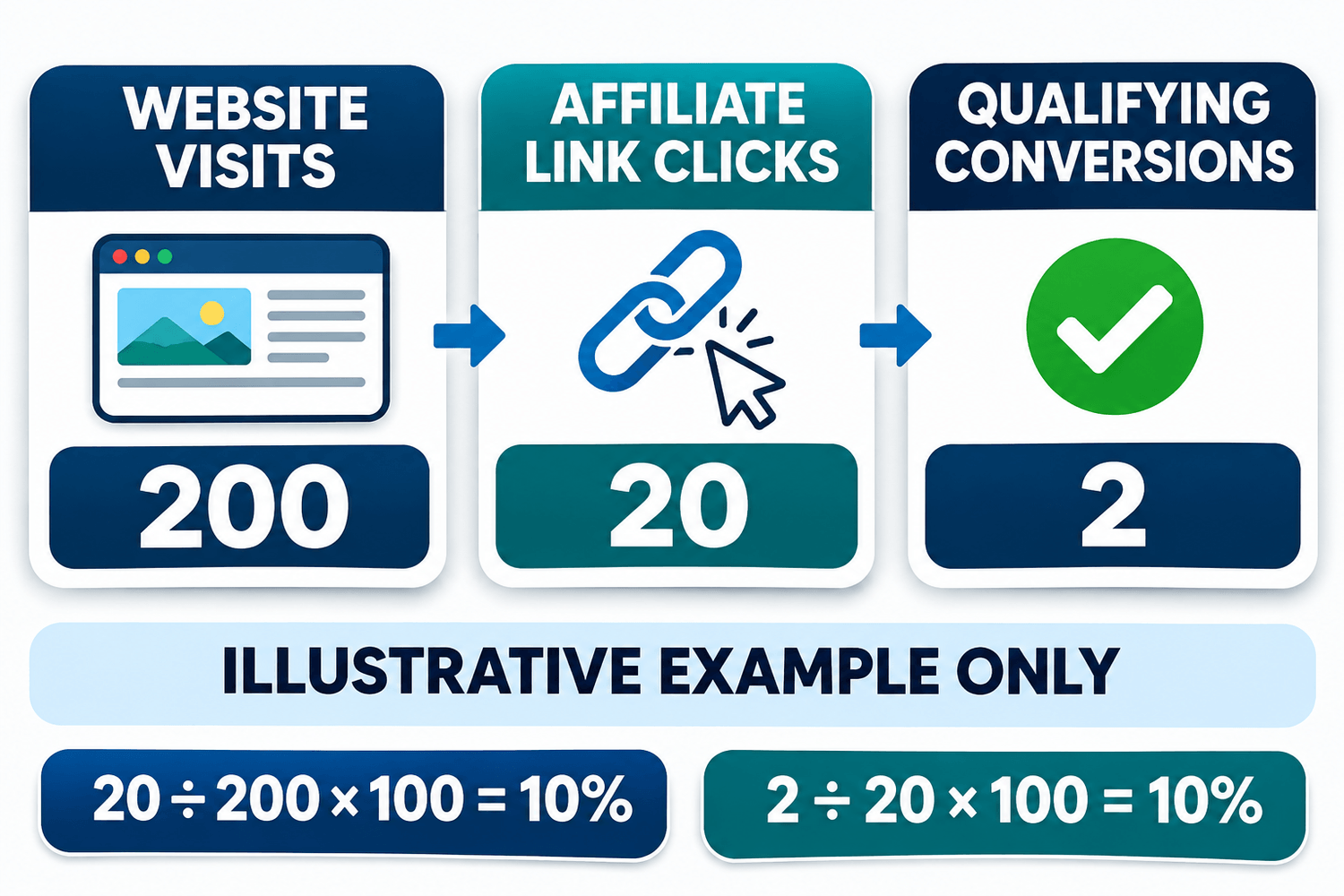
Consider this purely illustrative example:

Measurement Example
Website visits 200
Affiliate link clicks 20
Qualifying affiliate conversions 2

In this example, 20 affiliate link clicks out of 200 visits represent a 10% click-to-visit ratio, assuming the counts use compatible definitions and the same reporting period.

Two qualifying conversions out of 20 affiliate link clicks represent a 10% conversion-to-click ratio under those same assumptions.

These numbers are examples for explaining the calculations. They are not typical results, predictions, or evidence of actual campaign performance.

Also remember that different analytics and affiliate systems may count events differently. Compare their definitions before drawing conclusions.

Know When to Improve Your Strategy or Try Another Channel

Not every disappointing result requires changing platforms.

If people see your search listing but rarely click, examine whether the title and description accurately communicate the content's value.

If visitors arrive but leave without exploring, consider whether the page answers their questions and offers relevant next steps.

If affiliate links receive clicks but produce few qualifying conversions, examine offer relevance, visitor intent, and any information available from the affiliate program.

Avoid assuming that one metric explains the entire problem.

Review patterns across a meaningful period, taking your publishing frequency and traffic volume into account.

A channel change becomes more reasonable when you understand what you've tried, what you've learned, and why another approach may fit better.

Avoid Common Free Traffic Mistakes

Even a simple traffic strategy can become frustrating when expectations or habits work against your progress.

Here are three problems worth watching for.

Switching Traffic Methods Before Learning the Basics

It's tempting to abandon a traffic method when you hear about another platform that seems easier.

But constantly switching can prevent you from developing useful skills.

For example, someone learning SEO needs time to understand search intent, write useful articles, organize a website, and interpret performance information.

Changing to a completely different strategy after publishing only a few articles may leave important questions unanswered.

That doesn't mean you should continue indefinitely with something unsuitable.

Instead, decide what you want to learn from a method, complete a reasonable amount of work, and review the evidence before changing direction.

Promoting Affiliate Links Without Providing Useful Content

Affiliate marketing works best as a recommendation process rather than a race to distribute links.

People usually need context before deciding whether a product or service is relevant to them.

Explain what a tool does, who might benefit from it, what limitations matter, and what alternatives deserve consideration.

Be transparent about affiliate relationships.

A clear disclosure helps readers understand when you may receive compensation from a recommendation.

Avoid hiding important information, exaggerating product benefits, or placing affiliate links where they're not permitted.

Providing useful information gives readers a reason to pay attention beyond the promotional link itself.

Expecting Immediate Results From Organic Traffic

Organic traffic can develop unevenly.

A new article may receive little visibility. Another topic might attract interest sooner. Some channels may require repeated participation before you understand what resonates with an audience.

There isn't a reliable universal timeline for generating free affiliate marketing traffic.

Competition, content quality, audience demand, website accessibility, and channel behavior can all influence outcomes.

Be especially cautious of claims suggesting that publishing a certain number of articles or following a particular routine guarantees visitors or commissions.

Set goals around actions you control, such as researching topics carefully, creating useful content, and reviewing results.

Then use actual performance information to guide improvements.


Want to explore more ways to build your online marketing skills?

Discover additional beginner-friendly information and resources to help you develop your own approach to online marketing. My free report is included. Join Me Here.

WRITTEN BY

Tom Kimpton

Founder, Marketing With Tom

Tom Kimpton is the founder of Marketing With Tom, where he shares practical strategies for affiliate marketing, traffic generation, email list building, and making money online. He focuses on testing tools and strategies firsthand and sharing what he learns to help beginners build their online business.

READY FOR THE NEXT STEP?

Build Your Traffic and Email List With the Tools I Use

I’ve put together the resources I use and recommend for generating

traffic, building an email list, and growing an online business.

If you’re looking for a simple place to start, this is it.

Practical strategies for building traffic, growing an email list, and creating an online marketing business.

Start Here

New to online marketing?

Start with practical guides for generating traffic, building your email list, and creating a simple marketing system.

© 2026 Marketing With Tom. All rights reserved.