
How to Get Traffic to Affiliate Links for Free Without Spamming or Paying for Ads
Getting your affiliate links in front of people is relatively easy. Getting the right people to click on them is where things become more challenging.
You might have joined several affiliate programs, found products worth promoting, and shared your links wherever possible. Yet the clicks are barely coming in, and paying for advertising isn't an option.
Learning how to get traffic to affiliate links for free begins with understanding why someone would want to click in the first place.
Instead of constantly searching for somewhere else to post your links, focus on reaching people who have a problem your affiliate product can help solve. Give them useful information, demonstrate the value of your recommendation, and provide a natural next step.
You don't need thousands of followers or an expensive marketing setup to begin. You do, however, need a practical strategy that makes your promotional activities relevant to the people you're trying to reach.
Why Nobody Is Clicking Your Affiliate Links
Sharing Links Is Not the Same as Generating Traffic
Posting an affiliate link is a promotional activity, but it doesn't necessarily create interest.
Imagine someone scrolling through a social media feed and encountering a link to an unfamiliar product. There's no explanation of what it does, who it's designed for, or why they should consider it.
Most people have little reason to investigate further.
Effective affiliate promotion starts before someone sees your link. The surrounding content should establish enough relevance to make clicking a worthwhile decision.
Why Random Traffic Rarely Produces Meaningful Results
Not everyone who visits an affiliate offer is a potential customer.
If you're promoting an email marketing tool, reaching people interested in building an email list makes more sense than attracting visitors who have no interest in online marketing.
This is the difference between general traffic and targeted traffic.
A smaller audience with a genuine interest in your recommendation may be more valuable than a much larger audience clicking out of curiosity.
What Makes Someone Want to Click an Affiliate Link?
People are more likely to explore a recommendation when they understand what they might gain from it.
A useful tutorial, an informative comparison, or an explanation of how a product addresses a particular problem can provide that motivation.
Your affiliate link should feel like a logical next step rather than an interruption.
When your content answers an important question and introduces a relevant resource, readers can make a more informed decision about whether to explore it.

Build a Foundation for Free Affiliate Link Traffic
Match Your Affiliate Offer to a Specific Audience
Before choosing a traffic source, decide who you're trying to reach.
Promoting a product to everyone interested in making money online is a broad approach. Promoting a beginner-friendly email marketing tool to affiliate marketers who haven't started building an email list is considerably more specific.
Ask yourself three questions:
- Who would benefit most from this product?
- What problem are they currently experiencing?
- Where are they likely to look for help?
Your answers can guide everything from the content you create to the communities you participate in.
Understand the Problem Your Affiliate Product Solves
People aren't necessarily interested in buying another marketing tool. They may be looking for an easier way to collect subscribers, create landing pages, organize their promotions, or track their traffic.
Understanding that distinction helps you communicate practical benefits instead of simply repeating product features.
For example, rather than telling someone that a platform includes a landing page builder, explain how a landing page could help them collect email subscribers before promoting affiliate offers.
The product becomes relevant because you've connected it to something the reader wants to accomplish.
Give People a Genuine Reason to Click
Consider the difference between these two illustrative promotional messages.
Link-first promotion:
Want to make money online? Click my link and join today!
Value-first promotion:
Struggling to promote affiliate offers without an advertising budget? Here is a resource that explains how to start building a free traffic strategy.
The second message identifies a specific problem and explains what someone can expect to learn.
It doesn't require an exaggerated promise or aggressive sales pitch.
When the recommendation involves an affiliate relationship, include a clear disclosure so readers understand that you may earn a commission.
Useful information, relevant recommendations, and transparency create a much stronger foundation for responsible affiliate promotion.
How to Get Traffic to Affiliate Links for Free Without Spamming
Once you understand your audience and the problem your affiliate offer solves, you can begin attracting visitors through several free promotional methods.
The key is to use each method appropriately rather than treating every platform as another place to distribute links.
Create Helpful Content That Naturally Introduces Your Affiliate Offers
Content marketing gives you an opportunity to reach people who are actively looking for information.
You could create tutorials, comparison articles, beginner guides, product demonstrations, or answers to common questions within your niche.
Suppose you're promoting a landing page builder. Instead of publishing an article encouraging people to join the platform, create a guide explaining how to create an email signup page.
Walk readers through the process, explain what they need, and introduce a suitable tool where it becomes relevant.
Other content ideas include:
- How to solve a common problem within your niche.
- Comparing different approaches to completing a task.
- Explaining beginner mistakes and how to avoid them.
- Demonstrating how a particular product works.
Each piece of content creates an opportunity to attract interested visitors while helping them accomplish something useful.
Use Social Media to Educate Instead of Constantly Selling
You don't need a massive social media following to start promoting affiliate products.
Begin by publishing content that addresses the interests and challenges of your intended audience.
For example, an affiliate marketer promoting email marketing software could share a short educational post explaining three common mistakes people make when creating signup pages.
Interested readers could then be directed toward a more detailed tutorial or relevant resource through an appropriate link placement.
Where permitted, your profile can also serve as a starting point for people who want to discover more about your recommendations.
Check each platform's promotional policies before sharing affiliate links. Not every platform allows the same types of promotion.
Participate in Online Communities Without Breaking Their Rules
Online communities bring together people who share particular interests or challenges.
Rather than joining a community and immediately posting affiliate links, spend time understanding its members and contributing genuinely helpful information.
If someone asks how to start building an email list without a website, explain the available approaches and what they should consider before choosing one.
When relevant recommendations are permitted, you may have an opportunity to introduce a suitable resource.
However, if affiliate promotion is prohibited, respect that restriction.
Helpful participation can build credibility over time, even when you aren't directly promoting anything.
Use Free Publishing Platforms to Reach New Audiences
You don't necessarily need your own blog to publish educational articles.
A suitable free publishing platform can give you somewhere to create helpful content that readers may discover through search engines, platform recommendations, or shared links.
For instance, you could publish an article explaining how beginners can organize their affiliate marketing activities using free tools.
Where the platform permits affiliate recommendations, relevant links can be incorporated into the article.
Before committing to a publishing platform, review its content policies, affiliate link restrictions, and free publishing limitations.
Choose somewhere that supports your long-term content strategy rather than simply offering another place to post a link.
Use Permission-Based Safelist and Email Promotion
Safelists provide another potential promotional opportunity, particularly for affiliates targeting other online marketers.
Members of permission-based safelists generally participate with the expectation of receiving promotional messages under the service's membership arrangements.
This differs from collecting email addresses without permission and sending unsolicited promotions.
For example, if you're promoting a resource about free traffic generation, you could create a short promotional email explaining what marketers can learn from it.
However, audience relevance remains important. Safelist members may primarily be interested in promoting their own businesses, and traffic quality can vary.
Check the service's rules, available free participation options, affiliate program restrictions, and applicable email marketing requirements before promoting anything.
With your own permission-based email list, you can take a similar value-first approach by sharing helpful tips and occasionally introducing relevant affiliate recommendations.
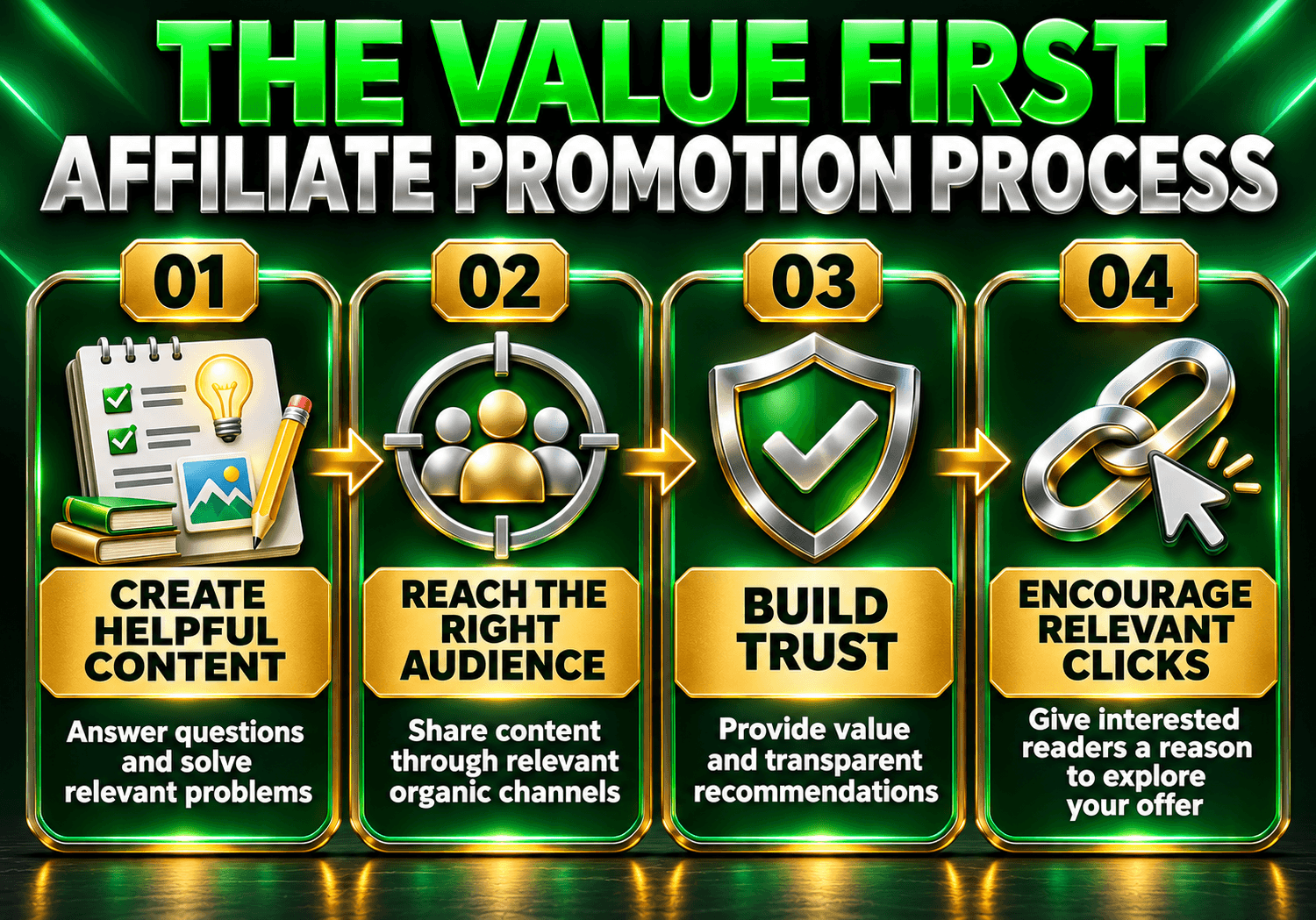
Where Should You Send Your Free Affiliate Traffic?
Generating interest is only part of the process. You also need to decide what happens when someone clicks your promotional link.
When Direct Affiliate Linking Makes Sense
Direct affiliate linking sends visitors straight to the product or service you're recommending.
This can be appropriate when your content has already explained the offer and the reader has enough information to decide whether to explore it.
For example, a detailed product tutorial might naturally include a link to the product's website.
Direct linking removes an additional step from the visitor's journey. However, it usually provides fewer opportunities to establish an ongoing relationship with that visitor.
Always confirm that both your promotional platform and affiliate program allow your intended linking method.
When a Landing Page Is the Better Option
A landing page gives you more control over how visitors are introduced to an offer.
Instead of sending someone directly to a product's sales page, you can explain what the product does, who it may benefit, and why it is relevant to the problem they're experiencing.
You could also use a landing page to offer a helpful report or educational resource in exchange for permission to send future emails.
An additional page isn't automatically better. Every extra step introduces another decision for the visitor.
Your landing page should provide meaningful value rather than simply act as an unnecessary barrier between the visitor and the affiliate offer.
| Traffic Destination | Main Benefit | Important Limitation |
|---|---|---|
| Direct Affiliate Link | Fewer steps before reaching the offer | Limited opportunity to build your own audience |
| Landing Page | Provides additional context | Adds another step to the visitor journey |
| Email Signup Page | Supports ongoing communication | Requires consent and continued email management |
Build an Email List Instead of Starting From Zero Every Day
One of the challenges of relying entirely on direct affiliate promotion is that you must continually attract new visitors.
Building an email list can help you develop an audience that has agreed to hear from you again.
You might attract someone with a free beginner's guide, send additional educational emails, and introduce affiliate products that address their interests.
Not every subscriber will purchase something, and building an engaged email list takes time.
However, permission-based email marketing allows you to continue providing value without depending entirely on finding new traffic every time you want to promote an offer.
Affiliate Link Promotion Mistakes That Can Hurt Your Results
Posting the Same Affiliate Link Everywhere
It can be tempting to copy the same promotional message and distribute it across every available platform.
The problem is that different audiences have different interests, expectations, and reasons for using those platforms.
A message appropriate for a promotional safelist may be completely unsuitable for an educational discussion community.
Adapt your message to the environment and the people you're trying to reach.
Consistency is valuable, but repetitive promotion without consideration for context can damage credibility.
Promoting Products to the Wrong Audience
An affiliate product can be useful without being appropriate for everyone.
Someone looking for their first free marketing tool may have little interest in an expensive advanced automation platform.
Likewise, a person searching for email marketing advice may not be interested in an unrelated business opportunity.
Before publishing a promotion, ask whether the offer genuinely helps the people who are likely to encounter it.
If the connection is difficult to explain, you may need a different audience, a different promotional approach, or a more relevant affiliate offer.
Ignoring Affiliate Disclosures and Platform Rules
Transparent affiliate marketing means being clear about your relationship with the products you recommend.
The U.S. Federal Trade Commission provides endorsement and affiliate disclosure guidance explaining the importance of making financial relationships apparent to readers. Disclosures should be easy to notice and understand, preferably close to the relevant recommendation.
An example might be:
I may receive a commission if you purchase through my links.
Commercial email promotions also have applicable requirements. In the United States, the FTC's CAN-SPAM compliance guidance explains obligations involving accurate sender information, honest subject lines, postal addresses, and unsubscribe mechanisms.
Always follow the relevant rules for your audience, promotional platform, affiliate program, and jurisdiction.
How to Track and Improve Your Free Affiliate Traffic
Track Where Your Affiliate Link Clicks Come From
If you're promoting the same affiliate offer through several channels, understanding where your visitors originate can help you make better decisions.
Depending on your affiliate program and available tracking tools, you may be able to identify clicks associated with different promotional activities.
You don't need a complicated tracking system to begin. A simple spreadsheet can help you organize your activities.
Here is an illustrative tracking record you could use:
| Tracking Detail | Educational Article | Safelist Promotion |
|---|---|---|
| Promotional Message | Email list tutorial | Free traffic resource |
| Link Clicks | Record actual clicks | Record actual clicks |
| Leads or Conversions | Record available data | Record available data |
| Observations | Review reader engagement | Review audience relevance |
| Next Improvement | Refine link placement | Improve promotional message |
Use actual information from your tracking tools rather than estimating results.
Focus on Traffic Quality Instead of Click Volume Alone
Clicks tell you that someone followed a link. They don't necessarily tell you whether that person was interested in purchasing anything.
A lead represents a further action, such as someone subscribing to your email list. A conversion occurs when a visitor completes the specific action you're measuring, such as making a purchase.
These are different stages of the marketing process.
Where the information is available, evaluate how visitors behave after clicking rather than judging a promotional method solely by its traffic volume.
Improve Your Promotions Based on Actual Results
Once you've collected some information, look for opportunities to improve.
If people are reading your content but rarely clicking your recommendations, examine whether your affiliate offer is relevant and whether its benefits are clearly explained.
If visitors reach your signup page but don't subscribe, review whether the page communicates a compelling and accurate reason to join.
Make manageable changes and observe what happens.
Changing your offer, audience, promotional message, and traffic source simultaneously makes it more difficult to understand which adjustment influenced your results.
Create a Simple 30-Day Affiliate Link Promotion Plan
You don't need to implement every free traffic method at once.
A focused 30-day plan can help you establish a practical promotional routine without spreading your time across too many activities.
Week 1: Choose Your Offer, Audience and Traffic Channels
Begin by selecting one affiliate offer that addresses a recognizable problem.
Identify the audience most likely to benefit from it and choose one or two promotional channels that match their interests.
Your preparation should include:
- Understanding the affiliate product and its intended audience.
- Identifying common questions potential customers ask.
- Reviewing promotional and affiliate program restrictions.
- Preparing your affiliate link or landing page.
- Establishing a simple tracking method.
Taking time to prepare can prevent unnecessary promotional activity later.
Weeks 2 and 3: Publish Helpful Content and Promote Consistently
During the second week, begin creating and sharing useful content.
You could publish an educational article, create social media posts addressing common questions, participate in relevant communities, or prepare permission-based email promotions.
Introduce affiliate recommendations where they genuinely belong.
During the third week, continue with your selected methods. Pay attention to questions people ask, the content they respond to, and the promotional activities that generate measurable interest.
Choose a publishing schedule you can realistically maintain.
Producing a few genuinely useful pieces of content may be more manageable than attempting to publish everywhere every day.
Week 4: Review Your Results and Improve Your Strategy
Use the fourth week to evaluate what you've learned.
Review available click data, subscriber activity, audience feedback, and any conversions reported through your affiliate program.
Identify which activities appear promising and where improvements may be needed.
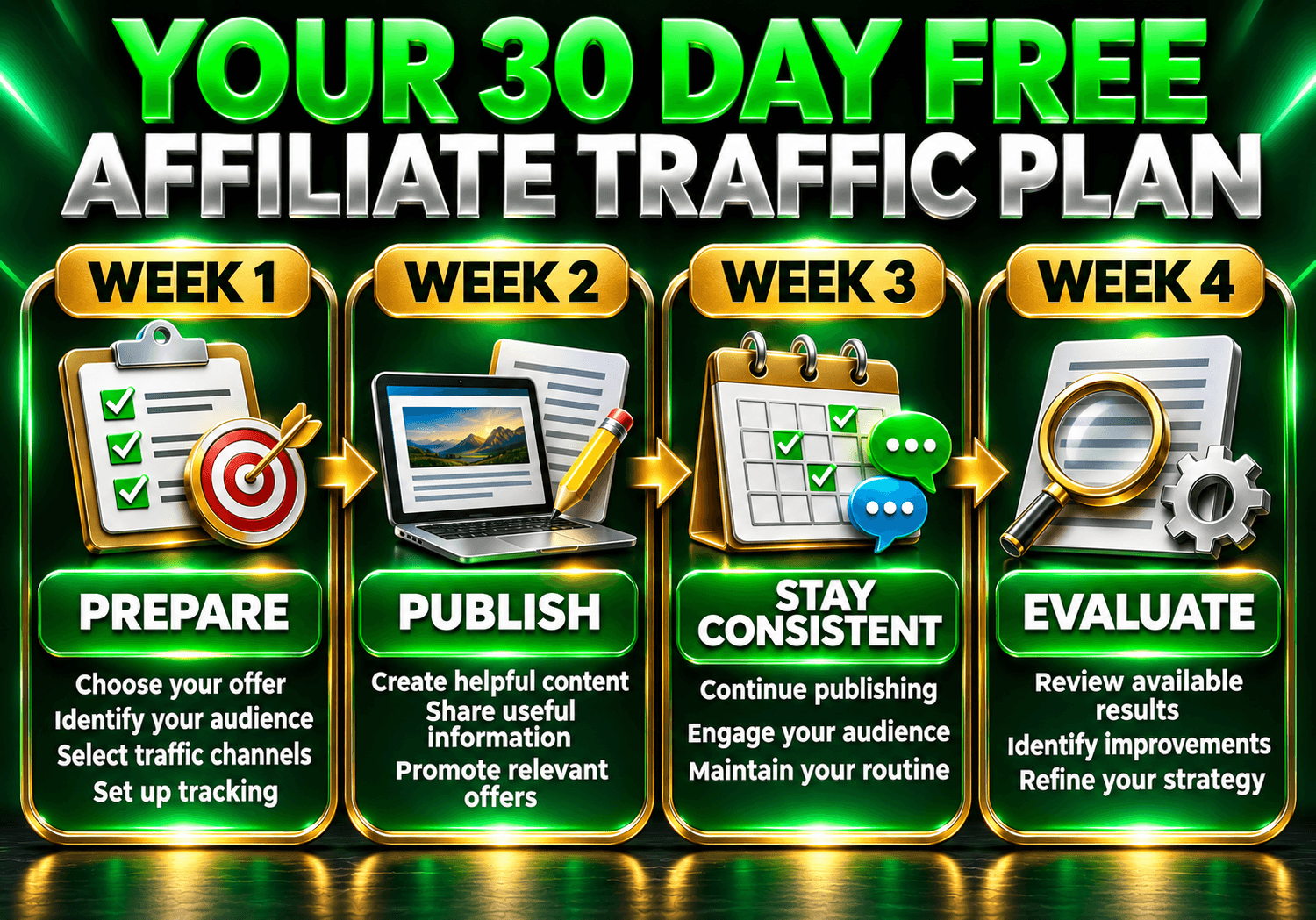
Your complete 30-day roadmap could look like this:
| Week | Primary Focus | Practical Objective |
|---|---|---|
| Week 1 | Prepare | Select an offer, audience, promotional channels, and tracking method |
| Week 2 | Publish | Create helpful content and relevant promotions |
| Week 3 | Stay Consistent | Continue publishing and engaging with your intended audience |
| Week 4 | Evaluate | Review available results and refine your strategy |
The purpose of this plan isn't to guarantee affiliate sales within 30 days. It's to help you establish a repeatable process, develop practical marketing experience, and make more informed decisions about your promotional activities.
Frequently Asked Questions
Can I Promote Affiliate Links for Free Without a Website?
Yes. Suitable social media platforms, online communities, publishing platforms, and landing page services can provide alternatives to maintaining a traditional website.
The important consideration is whether your chosen platform and affiliate program permit your intended promotional method.
Creating helpful content remains valuable even if you don't own the website where it's published.
Can I Get Traffic to Affiliate Links Without Social Media?
Yes. Search-oriented articles, permission-based email marketing, suitable publishing platforms, and relevant online communities can provide alternative opportunities.
You could focus on creating educational content that answers questions people are actively searching for.
These methods still require time, consistency, and an appropriate promotional strategy.
Is It Safe to Promote Affiliate Links Using Safelists?
Permission-based safelists can provide promotional opportunities, but their suitability depends on the service, affiliate program, recipient expectations, and applicable email marketing requirements.
Review the relevant rules before participating.
Also consider whether safelist members represent an appropriate audience for your affiliate offer. Receiving clicks doesn't necessarily mean you're attracting potential customers.
How Long Does It Take to Get Free Traffic to Affiliate Links?
There is no universal timeframe.
Some promotional activities may attract visitors relatively quickly, while search-oriented content and audience-building strategies can take considerably longer.
Your results will depend on your offer, audience, chosen promotional methods, content quality, and consistency.
Focus on developing a sustainable process and improving it using actual performance information rather than expecting results within a particular number of days.
Products / Tools / Resources
The following resources can help you establish a more organized and responsible affiliate promotion strategy.
-
Landing Page Builders
Look for a tool that allows you to create an appropriate landing page or email signup page. Review its free-plan limitations, publishing options, and affiliate marketing policies before committing.
-
Email Marketing Services
Choose a permission-based email marketing service that supports subscriber management, unsubscribe functionality, and the communication features you need.
-
Affiliate Link Tracking Tools
Consider a tracking tool or your affiliate program's existing reporting features to help identify which promotional activities generate clicks and measurable results.
-
Google Sheets or a Spreadsheet Application
A basic spreadsheet provides a practical way to organize promotional activities, record available performance data, and plan improvements without purchasing specialized tracking software.
-
FTC Endorsement and Affiliate Disclosure Guidance
An educational resource explaining transparent endorsements, financial relationships, and affiliate disclosure considerations.
-
FTC CAN-SPAM Act Compliance Guide
A useful reference for understanding U.S. commercial email marketing requirements.
Ready to Start Generating Free Traffic and Building Your Email List?
Struggling to attract visitors to your affiliate links without spending money on advertising?
Discover the copy-and-paste marketing approach I use to promote affiliate offers, generate leads, and build my online business.
I've put together a report explaining my approach so you can explore how it works and start applying these strategies to your own marketing efforts.
You don't need advanced technical skills or a large advertising budget to get started.

WRITTEN BY
Tom Kimpton
Founder, Marketing With Tom
Tom Kimpton is the founder of Marketing With Tom, where he shares practical strategies for affiliate marketing, traffic generation, email list building, and making money online. He focuses on testing tools and strategies firsthand and sharing what he learns to help beginners build their online business.
READY FOR THE NEXT STEP?
Build Your Traffic and Email List With the Tools I Use
I’ve put together the resources I use and recommend for generating
traffic, building an email list, and growing an online business.
If you’re looking for a simple place to start, this is it.

Practical strategies for building traffic, growing an email list, and creating an online marketing business.
Start Here
New to online marketing?
Start with practical guides for generating traffic, building your email list, and creating a simple marketing system.
© 2026 Marketing With Tom. All rights reserved.