
No Audience? Here's How to Get Your First 100 Email Subscribers
You want to start building an email list, but there's one problem: nobody knows who you are yet.
You don't have thousands of followers, an established blog, or a steady stream of website visitors. Maybe you've already created a signup form and wondered how anyone is supposed to find it.
Here's something worth understanding: you don't need an existing audience to start building an email list. You need a way to reach people who might benefit from what you're offering.
Your first 100 subscribers won't necessarily arrive quickly. Some methods require patience, and others take consistent effort before producing noticeable results.
But you can start with a simple process: identify the right people, give them a reason to subscribe, create an easy signup experience, and share helpful information where those people already spend time.
Here's how to put that process together.

1. Why You Don't Need an Audience to Start an Email List
What Your First 100 Subscribers Really Represent
Your first 100 email subscribers aren't just a number on a dashboard.
They're people who have expressed interest in receiving something from you.
For an affiliate marketer, that might mean people interested in learning how to choose products or generate traffic. For a blogger, it could be readers who want more practical advice about a particular subject.
The important distinction is relevance.
A list of 30 subscribers who genuinely care about your topic may provide more useful feedback than a much larger list of people who barely remember subscribing.
Rather than treating 100 subscribers as proof of success, think of the milestone as an opportunity to learn what attracts your audience.
The Difference Between Followers and Email Subscribers
Social media followers and email subscribers aren't quite the same.
Someone might follow your account because they enjoyed one post. An email subscriber has taken an additional step by providing an address and agreeing to receive messages.
That doesn't automatically make every subscriber engaged. People can lose interest, unsubscribe, or stop opening emails.
However, email gives you a direct communication channel that isn't dependent on someone seeing your next social media post.
You still depend on email providers, delivery systems, and permission-based marketing practices, but you have a way to communicate with people who have requested your messages.
What You Actually Need Before You Start
You don't need an expensive website, complicated funnel, or dozens of marketing tools.
Start with three essentials:
- A clearly defined audience with a problem you can help solve.
- A useful reason for someone to join your email list.
- An email marketing service and signup page that collect subscriptions.
You'll also need a way to attract visitors, but that can begin with free content and participation in relevant communities.
Keep your initial setup manageable. A simple system that works is more useful than an elaborate one you never finish.
2. Choose Who You Want on Your Email List
Identify One Specific Audience and Problem
Before creating a lead magnet or signup page, answer one question:
Who would benefit from receiving your emails?
“People interested in making money online” is a broad audience.
“Beginners learning affiliate marketing without paid advertising” is more specific.
That distinction helps you decide what to teach, which problems to address, and where to find potential subscribers.
You don't have to narrow your niche permanently. You're simply choosing a useful starting point.
For example, a beginner gardening publisher might focus on apartment residents who want to grow vegetables in small spaces.
A clear audience makes your message easier to understand.
Give People a Clear Reason to Subscribe
Consider these two signup invitations:
“Subscribe to My Newsletter.”
“Get a Beginner Checklist for Starting Affiliate Marketing Without a Website.”
The second explains what someone will receive and who it's intended to help.
That doesn't mean it will automatically convert better. But it gives potential subscribers more information for deciding whether the offer is relevant.
Your signup message should answer three questions:
What will I receive? How will it help me? What kinds of emails should I expect afterward?
Clarity builds more appropriate expectations than vague promises.
Choose a Free Offer That Matches Their Needs
A lead magnet is a useful resource offered in exchange for someone voluntarily subscribing to your email list.
It doesn't have to be a 50-page ebook.
You could create a checklist, short guide, worksheet, template, or beginner tutorial.
Suppose your audience wants to learn free traffic generation. A checklist outlining five ways to begin attracting relevant visitors could be a practical starting resource.
Make the offer specific enough to solve one manageable problem.
And make sure you can actually deliver what you promise.
3. Set Up a Simple Email Signup System
Choose an Email Marketing Platform
An email marketing platform helps you collect subscribers, manage your list, and send messages.
Some services offer free or limited plans, while others require payment or restrict certain features.
Before choosing one, compare the capabilities that matter to you:
- Signup forms or hosted landing pages.
- Subscriber management and consent records.
- Welcome emails and basic automation.
- Email sending limits and upgrade costs.
You don't necessarily need advanced automation when you're collecting your first subscribers.
Choose a platform that supports your immediate needs and that you can operate comfortably.
Verify current pricing and feature restrictions directly with the provider before committing.
Create a Landing Page or Signup Form
Your signup page has one main job: help interested visitors understand the offer and decide whether to subscribe.
A basic page can include a clear headline, a short explanation of the resource, an email field, and an obvious signup button.
Avoid cluttering the page with unrelated offers.
If you're offering a free checklist, explain what the checklist covers rather than filling the page with broad marketing promises.
A full website isn't always necessary. A hosted landing page may be sufficient, depending on your email platform.
Before sharing the page, test it on your phone and computer.
Make sure the form works, the text is readable, and subscribers know what they're agreeing to receive.
Deliver Your Free Offer and Welcome Email
After someone subscribes, the promised resource should be easy to access.
Depending on your platform, you might deliver it through a welcome email or a confirmation page.
A simple welcome email can thank subscribers, provide the resource, and explain what future messages will cover.
Avoid immediately overwhelming new subscribers with unrelated promotions.
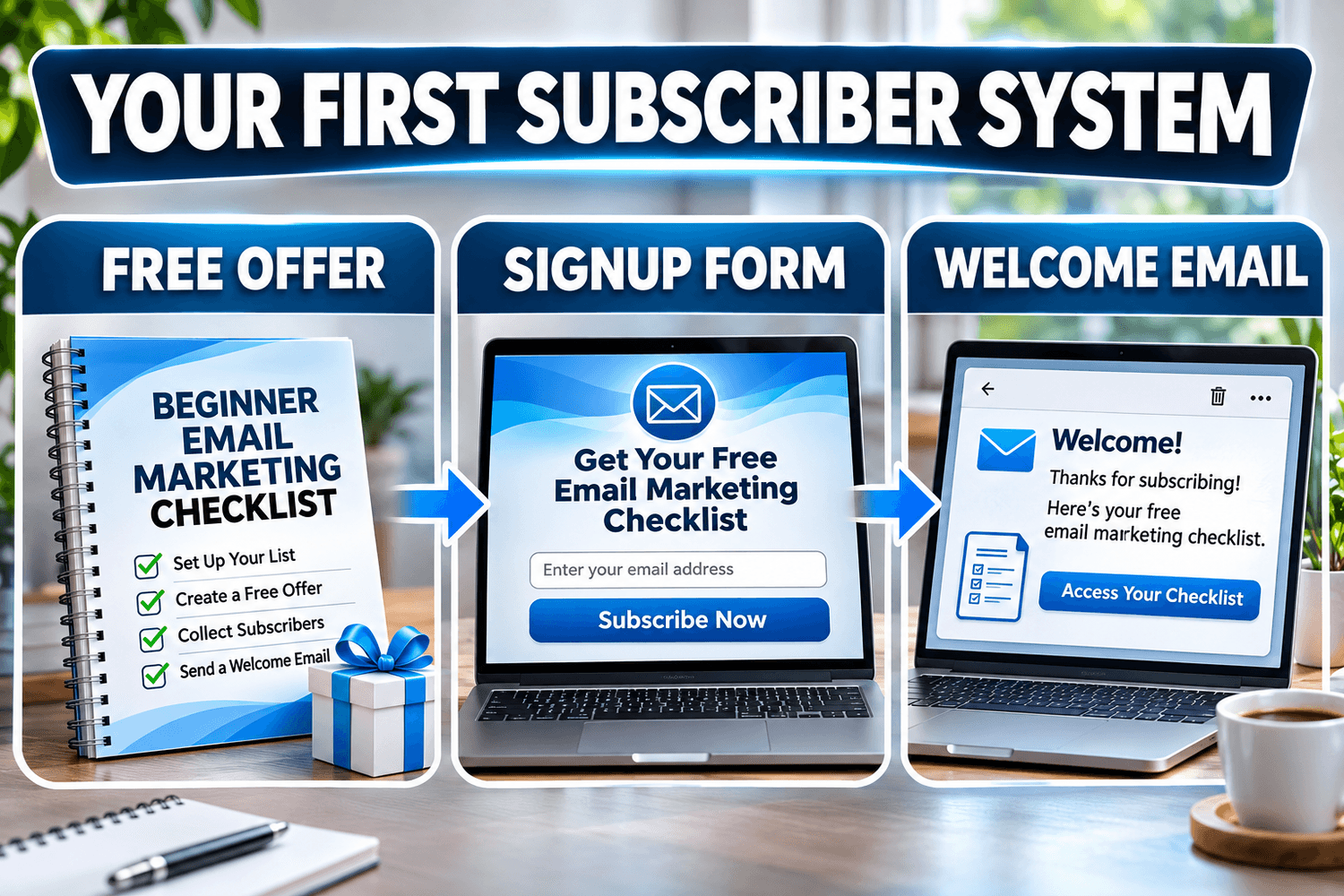
Minimum setup checklist
Your Signup System
- Choose an email marketing service
- Create a focused signup page
- Explain the subscription offer
- Connect the form to your email list
- Set up resource delivery and a welcome email
- Test the signup process from start to finish
Once the complete signup process works, you're ready to focus on attracting visitors.
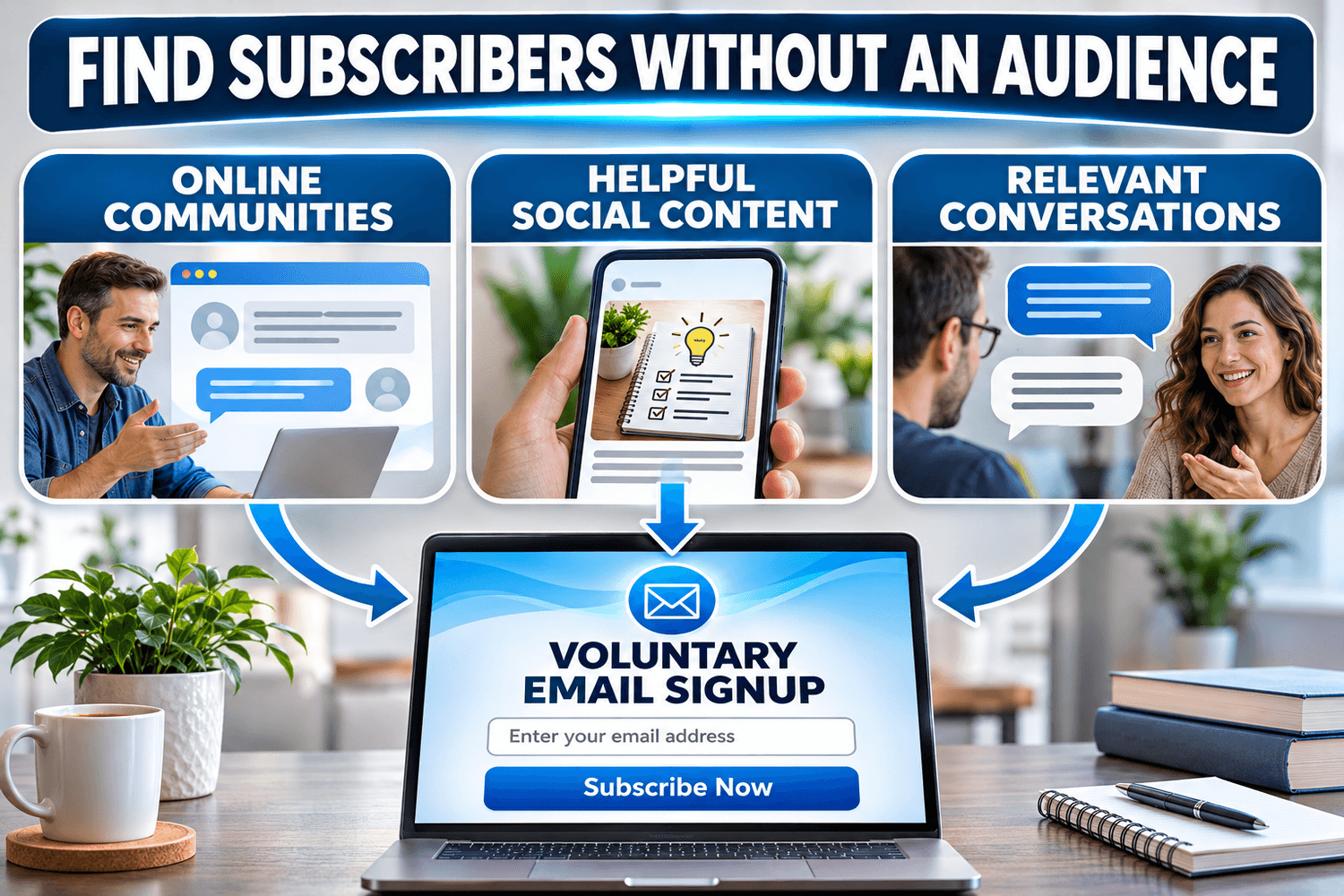
4. Find Your First Subscribers Without an Existing Audience
Participate in Relevant Online Communities
One way to begin reaching people is to participate in communities where your intended audience already asks questions.
These might include niche forums, discussion groups, or topic-specific online communities.
Your first objective shouldn't be posting your signup link everywhere.
Instead, look for questions you can answer thoughtfully.
For example, if someone asks how to begin affiliate marketing without a website, you might explain several realistic starting options.
If the community permits relevant resource sharing, you can occasionally mention a useful guide.
Respect the rules of each community. Some prohibit promotional links entirely.
The goal is to become a helpful participant, not to treat every conversation as an advertising opportunity.
Share Helpful Content on One Social Platform
You don't need to establish a presence on five social networks simultaneously.
Choose one platform that fits your topic and preferred content format.
Then publish useful information consistently.
For example, an affiliate marketing beginner could share short explanations about choosing a niche, comparing traffic methods, or avoiding common mistakes.
Each piece should provide value even if nobody visits your signup page.
When appropriate, your profile can explain what you help people learn and provide a link to your free resource.
Remember that publishing content doesn't guarantee distribution. Experiment with useful topics and pay attention to the questions people ask.
Use Personal Connections and Relevant Conversations
Your existing network may include people interested in your topic, even if you don't have a formal audience.
That doesn't mean adding friends, relatives, or professional contacts to your email list without permission.
Instead, have genuine conversations when your topic is relevant.
If someone expresses interest in a resource you've created, you can explain where they can voluntarily subscribe to receive it.
Here's an illustrative example.
A new affiliate marketer creates a checklist about choosing a first traffic source. They answer questions in a relevant community, publish helpful explanations, and make the checklist available through their profile where permitted.
Some interested readers may choose to subscribe.
This approach doesn't guarantee subscribers, but it creates opportunities for people to discover the resource without requiring an established following.
5. Build Repeatable Traffic That Can Grow Your List
Create Content Around Questions Your Audience Asks
Early conversations can reveal what people want to understand.
Pay attention to recurring questions, confusing terminology, and problems beginners describe.
Those observations can become useful content topics.
For instance, someone interested in email marketing might ask whether they need a website, how to create a lead magnet, or what to send new subscribers.
An article answering one of those questions can also introduce a relevant resource.
Focus on solving the problem rather than inserting signup invitations into every paragraph.
Helpful content gives visitors a reason to trust the information before deciding whether they want more.
Turn Blog Posts Into Subscriber Opportunities
If you have a blog, individual articles can introduce readers to your email list.
The strongest connection usually comes from matching the subscription offer to the article's subject.
Imagine someone reading an article about creating their first lead magnet.
A downloadable lead magnet planning worksheet could be a natural next resource.
A generic offer about an unrelated subject would be less relevant.
Signup opportunities can appear within articles or near relevant content, provided they don't interrupt the reading experience unnecessarily.
For a deeper explanation, see this guide on getting email subscribers from blog posts.
Organic search may eventually help readers discover useful articles, but new publishers shouldn't assume that publishing automatically produces search traffic.
Repurpose Helpful Content Across Relevant Channels
You don't need a completely different idea for every platform.
One well-researched article can support several smaller pieces of content.
For example, an article about free traffic methods could become a short social post explaining one method, a checklist highlighting common mistakes, and a useful answer to a relevant community question.
Adapt each piece to its context rather than posting identical promotional messages everywhere.
The purpose of repurposing is to make useful information accessible in different formats.
Over time, you'll learn which subjects generate questions, conversations, and visits to your signup page.
6. Track Your Progress Toward 100 Subscribers
Measure Visitors, Signups, and Subscriber Quality
You don't need complicated analytics to begin understanding your results.
Start with the number of visitors reaching your signup page, how many subscribe, and where those visitors came from.
One useful metric is your visitor-to-subscriber conversion rate.
Suppose your landing page receives 200 visits and 10 subscriptions.
Illustrative Signup Conversion Calculator
- Page visits: 200
- Subscriptions: 10
- Visitor-to-subscriber conversion rate: 5.0%
10 ÷ 200 × 100 = 5.0% This is an illustrative calculation, not a typical or promised result.
Numbers alone don't tell the complete story.
Consider whether subscribers are genuinely interested in your topic, whether addresses are confirmed when required, and whether people engage with your messages.
Find Out Why People Aren't Subscribing
If visitors reach your page but few subscribe, investigate possible reasons.
Maybe the offer isn't specific enough. Perhaps the page doesn't explain what subscribers will receive, or the form is difficult to use on mobile devices.
Sometimes the problem is traffic relevance: visitors may simply be looking for something different.
Don't assume every low conversion rate has the same cause.
Review the available evidence before making changes.
Improve One Part of Your Process at a Time
Changing your headline, lead magnet, signup form, and traffic strategy simultaneously makes it difficult to understand what helped.
Instead, begin with one reasonable improvement.
You might clarify your offer, simplify the signup form, or adjust how you introduce the resource.
Then monitor what happens as additional visitors arrive.
Small traffic volumes can produce highly variable results, so avoid treating a handful of signups as conclusive evidence.
The goal is gradual learning, not chasing a perfect conversion percentage.
7. Create a Sustainable Plan for Your First 100 Subscribers
Set Small Weekly Subscriber-Building Goals
Reaching your first 100 subscribers is easier to approach when you focus on activities you can control.
Instead of promising yourself a particular subscriber total every week, choose manageable tasks.
You might create one helpful piece of content, participate meaningfully in relevant discussions, and review your signup activity.
Here's an illustrative routine you can adapt:
| When | Suggested Activity |
|---|---|
| Monday | Research one audience question |
| Tuesday | Create or improve useful content |
| Wednesday | Share the content appropriately |
| Thursday | Participate in relevant discussions |
| Friday | Review visits, signups, and feedback |
This is an organizational example, not a guaranteed subscriber-growth formula.
Focus on One Main Traffic Source First
When you're starting from zero, spreading your attention across too many platforms can make consistent progress difficult.
Choose one primary channel based on where your audience is likely to spend time and what you can maintain.
If you enjoy writing, useful articles may be a natural starting point.
If you prefer short educational posts, a relevant social platform may be more manageable.
You can experiment with additional channels later.
Concentrating your effort initially makes it easier to recognize what is and isn't working.
Keep Helping Subscribers After They Join
Getting someone to subscribe is the beginning of the relationship, not the finish line.
Your welcome email should deliver what you promised and establish reasonable expectations.
Future emails should continue addressing the problems that attracted subscribers in the first place.
If someone joined for beginner email marketing guidance, sending unrelated promotions immediately may weaken their interest.
Give subscribers useful information, respect their preferences, and make unsubscribing straightforward.
Your next step is simple: choose one audience, prepare one genuinely useful offer, and create a working signup page. Then begin sharing helpful information through one suitable discovery channel.
You don't need an audience of thousands to start. You need a process that gives the right people a reason to join.
Frequently Asked Questions
Can You Get 100 Email Subscribers Without a Website?
Yes. A full website isn't always necessary. Some email marketing platforms provide hosted landing pages or signup forms that can collect subscribers. You'll still need a suitable way to attract interested visitors and follow applicable consent requirements.
How Long Does It Take to Get Your First 100 Email Subscribers?
There isn't a reliable universal timeframe. Results depend on your offer, audience relevance, traffic sources, consistency, and other factors. Focus on improving your process rather than relying on a fixed deadline.
Do You Need to Pay for Email Marketing Software?
Not necessarily. Some providers offer free or limited plans suitable for beginners. Features, subscriber limits, and sending restrictions vary, so review current provider terms before selecting a service.
Should You Buy an Email List to Get Started Faster?
Buying an email list is generally a poor approach for beginners. Purchased contacts may have little interest in your topic, and their use can create consent, deliverability, and email-provider compliance problems. Building a permission-based list gives people a clear opportunity to choose whether they want your messages.
Products / Tools / Resources
Email Marketing Platform: Choose a reputable service that supports signup forms, subscriber management, and welcome emails. Verify current pricing and capabilities before subscribing.
Landing Page or Form Builder: Use a hosted signup page or a compatible website form to explain your offer and collect voluntary subscriptions.
Lead Magnet Creation Tool: A basic document editor or design tool can help you create a checklist, worksheet, or short guide.
Subscriber Tracking: Use your email platform's reporting features or a simple spreadsheet to monitor visitors, subscriptions, and acquisition sources.
Email Compliance Guidance: The FTC's CAN-SPAM Act Compliance Guide explains important U.S. commercial email requirements. Additional laws may apply depending on your location and subscribers.
Ready to Start Building Your First Email List?
You don't need thousands of followers, paid advertising, or a complicated website to get started.
Focus on one audience, create something genuinely helpful, and give interested people a simple way to subscribe.
Your first 100 subscribers start with one useful offer and one person choosing to join.
Start small, stay consistent, and build an email list based on trust—not hype.

WRITTEN BY
Tom Kimpton
Founder, Marketing With Tom
Tom Kimpton is the founder of Marketing With Tom, where he shares practical strategies for affiliate marketing, traffic generation, email list building, and making money online. He focuses on testing tools and strategies firsthand and sharing what he learns to help beginners build their online business.
READY FOR THE NEXT STEP?
Build Your Traffic and Email List With the Tools I Use
I’ve put together the resources I use and recommend for generating
traffic, building an email list, and growing an online business.
If you’re looking for a simple place to start, this is it.

Practical strategies for building traffic, growing an email list, and creating an online marketing business.
Start Here
New to online marketing?
Start with practical guides for generating traffic, building your email list, and creating a simple marketing system.
© 2026 Marketing With Tom. All rights reserved.