How to Make Your First $100 Online by Focusing on Your First Sale

Making your first $100 online can feel like a big challenge when you've never earned anything through the internet before. You might wonder whether you need a website, thousands of followers, expensive software, or special technical skills just to get started.

The good news is that you don't necessarily need all those things. What you do need is a realistic way to offer something valuable, reach people who might need it, and give them a reason to consider buying.

Instead of concentrating entirely on the $100 goal, consider starting with something smaller: your first legitimate online sale.

That first transaction might earn you $5, $20, or another amount depending on the product, service, or commission structure. It won't automatically lead to more sales, but it can help you understand how online earning works in practice.

This guide explains how to make your first $100 online by choosing a beginner-friendly earning method, finding a relevant offer, attracting potential buyers, and building a practical first-sale plan without relying on paid advertising.

Why Your First Online Sale Matters More Than Chasing $100 Immediately

A $100 income target is easy to understand, but it doesn't tell you what actions are required to reach it.

Focusing on your first sale gives you a more specific starting point.

What Counts as Your First Online Sale?

An online sale generally happens when someone purchases a product or service through an internet-based transaction.

However, what you actually earn depends on your business model.

For example:

  • Affiliate marketing: Someone makes a qualifying purchase through your referral link, and you may earn a commission.
  • Freelancing: A client pays you to complete an agreed service.
  • Digital products: Someone purchases a downloadable resource you created.

These transactions don't all work the same way.

If someone buys a $50 product through your affiliate link and the program pays a 10% commission, your potential commission would be $5, assuming the transaction qualifies.

The $50 purchase isn't your income.

Understanding that difference is important when calculating your progress.

Why Your First Sale Is an Important Learning Milestone

Your first sale can give you useful information.

It may indicate that someone found your offer relevant enough to make a purchase. It can also help you understand how customers discover your content, evaluate recommendations, and complete transactions.

But one sale doesn't prove that a method will consistently produce income.

A better approach is to treat it as an opportunity to learn.

Ask yourself what problem the buyer wanted solved, how they discovered the offer, and whether you can improve the experience for future visitors.

How One Sale Can Help You Work Toward $100

Suppose you earn $10 from your first qualifying affiliate sale.

You would still need another $90 in net earnings to reach your $100 target.

If future sales also earned $10 each, reaching $100 would require ten qualifying sales in total.

That's simple arithmetic, not an earnings prediction.

Your actual results will depend on demand, offer relevance, commission terms, traffic, and whether people decide to purchase.

The important change is that you're working toward a measurable goal rather than chasing an undefined promise of online income.


Choose a Beginner-Friendly Way to Make Your First Sale

There are many ways to earn money online, but you don't need to try all of them.

Start by selecting a method that fits your skills, interests, available resources, and willingness to learn.

Affiliate Marketing and Referral Commissions

Affiliate marketing involves recommending products or services through an authorized referral arrangement.

When someone completes an action that qualifies under the program's terms, you may receive a commission.

For example, you could publish a helpful article explaining how beginners can organize their email marketing efforts. If you participate in a suitable affiliate program, you might recommend a relevant tool.

The recommendation should help the reader make an informed decision rather than simply encourage a click.

Affiliate marketing can be attractive because you generally don't need to manufacture the product or manage its delivery.

However, you still need to attract relevant visitors, earn their trust, understand program rules, and disclose commission relationships appropriately.

Freelance Services and Beginner-Friendly Skills

Freelancing allows you to sell a service directly to a customer.

Possible services include proofreading, basic graphic design, document formatting, virtual assistance, and simple content editing.

You don't necessarily need an advanced professional background to offer every type of service, but you do need to deliver work that meets the client's expectations.

For example, someone comfortable organizing documents might offer a clearly defined formatting service.

The key is to begin with something you can perform competently, describe exactly what's included, and agree on payment and delivery expectations before starting.

Unlike affiliate marketing, freelancing usually involves direct responsibility for completing the work.

Digital Products and Simple Online Offers

Digital products are resources customers can purchase and receive electronically.

Examples include planning worksheets, templates, printable organizers, and educational guides.

A useful digital product solves a specific problem.

For instance, a beginner-friendly weekly content planner could help small business owners organize their publishing tasks.

Creating a product doesn't guarantee demand, though. You'll still need to understand the audience, explain the benefit clearly, and find a way to reach interested buyers.

Before choosing a method, compare the basic requirements.

Method What You Need Main Challenge
Affiliate marketing Relevant offers and a way to reach an audience Generating qualifying conversions
Freelancing A useful skill and ability to deliver Finding and serving clients
Digital products A useful resource and delivery method Creating demand and attracting buyers

Choose one method to explore first. You can always expand later when you understand what works for your situation.

Find a Product or Service People Actually Need

Choosing an earning method is only the beginning.

Your next task is identifying something people have a genuine reason to purchase.

Identify a Specific Problem Your Audience Wants Solved

People usually consider buying because they want to solve a problem, save time, learn something, or achieve a particular outcome.

Begin by identifying a specific audience and the questions they ask.

For example, someone starting an email list might need help creating a signup form, choosing a beginner-friendly email service, or preparing a welcome message.

Those are more useful starting points than simply searching for whichever affiliate product advertises the highest commission.

Look for recurring questions in search results, relevant communities, and discussions about the topic.

Your goal is to understand the problem before selecting a solution.

Evaluate Products, Services, and Affiliate Offers

A relevant offer should match the audience's actual needs.

Consider whether the product or service is understandable, reasonably suited to beginners, and supported by clear information about what customers receive.

If you're promoting an affiliate product, examine the provider's documentation and customer-facing terms.

If you're selling your own service, describe the deliverables and limitations accurately.

If you're creating a digital product, make sure it provides meaningful value rather than repackaging information that doesn't help the buyer.

Avoid claiming you've personally tested a product unless you actually have.

Check Trustworthiness, Costs, and Earning Potential

Before committing to an offer, review the details.

A simple evaluation checklist can help:

  • Does the offer address a specific customer problem?
  • Are the product's features and limitations explained clearly?
  • Are pricing, fees, and refund conditions understandable?
  • Does the provider appear credible?
  • Are affiliate commission and payment conditions documented?
  • Can you promote the offer honestly without exaggerated claims?

Be cautious about programs emphasizing unusually large income promises while providing little explanation of the actual product or service.

An attractive commission is not useful if the offer is unsuitable for your audience.

Build a Simple Path From Interest to Your First Sale

Once you've chosen an offer, you need a way for potential customers to discover it.

This doesn't require an elaborate marketing system. A straightforward process is often easier to understand and improve.

Choose One Place to Reach Potential Customers

Beginners can explore several channels, including blogs, suitable social platforms, and communities that permit relevant promotional activity.

A blog allows you to publish detailed educational content that people may discover through search engines.

Social platforms can help you share shorter explanations, examples, and answers.

Online communities can provide opportunities to learn what people need and contribute helpful information.

Each channel has different rules and challenges.

Choose one that fits the audience and the type of content you're comfortable creating.

Create Helpful Content That Answers Buyer Questions

Helpful content connects a reader's question to useful information.

Suppose you're promoting a beginner-friendly email marketing tool.

Instead of publishing a message that simply says to buy it, you could explain how someone can choose an email service, what features matter, and which limitations to consider.

A reader interested in solving that problem may then decide to explore your recommendation.

This approach respects the reader's decision-making process.

It also gives your content a purpose beyond displaying promotional links.

Guide Interested Readers Toward a Relevant Offer

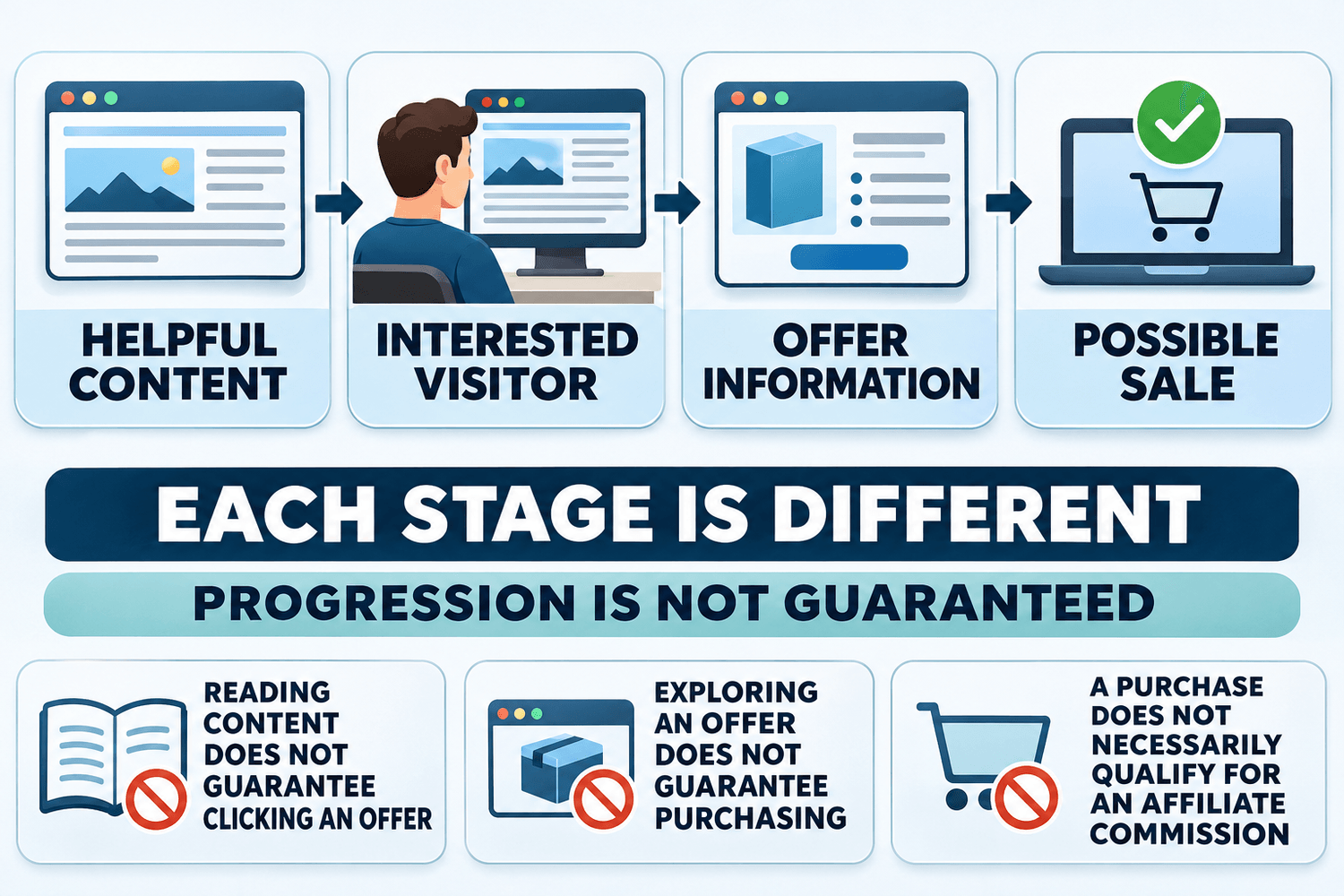
A basic customer journey might look like this:

Helpful content → Interested visitor → Offer information → Possible qualifying sale

Each stage is separate.

Someone reading your article doesn't necessarily click a link. Someone clicking a link doesn't necessarily purchase. And a purchase doesn't necessarily qualify for an affiliate commission.

When recommending affiliate products, clearly explain any commission relationship near the relevant recommendation.

The Federal Trade Commission advises that material relationships be disclosed clearly and conspicuously so consumers can evaluate endorsements appropriately.

See the FTC's Endorsement Guides for additional guidance.

An email list may help you communicate with interested readers over time, but it's not a requirement for every first-sale strategy.

Get Your First Potential Buyers Without Paid Advertising

Paid advertising isn't the only way to introduce people to an offer.

Organic approaches can help beginners develop marketing skills without purchasing advertisements, although they still require effort and may involve other costs.

Answer Questions People Are Already Searching For

One approach is creating content around questions your intended audience is asking.

For example, someone researching email marketing might search for ways to start an email list without a website.

An article addressing that question could explain available options, important limitations, and practical starting steps.

If the content is useful and discoverable, it may attract relevant visitors.

However, publishing an article doesn't guarantee search visibility or traffic.

Concentrate on answering the question thoroughly instead of repeating keywords unnecessarily.

Share Useful Content in Relevant Online Communities

Relevant communities can help you understand your audience and contribute useful information.

Look for discussions where you can genuinely answer questions based on your knowledge.

If someone asks how to organize a simple content calendar, a practical explanation may be more welcome than an unsolicited promotional link.

Always follow community rules.

Some groups prohibit affiliate links, self-promotion, or repeated posting.

Respecting those rules helps keep your participation useful rather than intrusive.

Build Trust Before Asking Someone to Buy

People need enough information to make their own decisions.

Trust can develop when your content is accurate, transparent, and relevant to their concerns.

Explain both benefits and limitations. Avoid pretending every product is perfect or every strategy works for everyone.

If you receive a commission from a recommendation, disclose that relationship.

You don't need to make every piece of content promotional.

Sometimes the most useful thing you can do is answer a question clearly, even when the answer doesn't immediately lead to a sale.

Turn Your First Sale Into a Plan for Earning $100

Once you understand the basic sales process, you can connect your first transaction to the larger earnings goal.

The calculations are straightforward, but it's important to use the amount you actually earn rather than the product's selling price.

Calculate How Many Sales You Would Need to Earn $100

Start with the net amount earned per qualifying sale, before personal income taxes.

Then divide $100 by that amount.

For example, if you earn $20 per sale:

$100 ÷ $20 = 5 sales

Here are several illustrative scenarios:

Net Earnings Per Sale Sales Needed for $100
$520
$1010
$205
$254
$502

These examples assume each qualifying sale produces the stated amount after applicable transaction costs. They don't predict how many sales you'll make.

If your earnings vary from transaction to transaction, you'll need to add the actual amounts instead.

Understand Commissions, Fees, Refunds, and Actual Earnings

Not every sale produces the amount you initially expect.

Affiliate programs may have qualifying conditions, payment schedules, refund periods, or minimum payout thresholds.

Digital product platforms may deduct transaction or service fees.

Freelancers may incur expenses while completing a project.

For example, a $25 sale with $5 in applicable costs leaves $20 before income taxes.

That distinction matters when measuring your progress.

Also, earning a commission in an account dashboard doesn't necessarily mean the money is available for withdrawal.

Keep accurate records of transactions, fees, refunds, and payments.

For U.S. readers, online business and gig income can create tax obligations. The IRS Gig Economy Tax Center explains general reporting and recordkeeping responsibilities.

Improve Your Process Using What You Learn

Your first attempts can provide information even when they don't produce sales.

Look at relevant indicators such as:

  • How many people discover your content.
  • Whether visitors engage with the information.
  • How many people click through to an offer.
  • Whether qualifying sales are recorded.
  • What questions or objections appear repeatedly.

These measurements describe different actions.

A large number of visits doesn't automatically mean strong buyer interest, and link clicks don't guarantee conversions.

Use the available information to identify one reasonable improvement at a time.

Avoid Common Mistakes That Prevent Beginners From Making Sales

Beginners often face obstacles that have more to do with unclear direction than a lack of effort.

Recognizing common problems can help you make better decisions.

Promoting Too Many Unrelated Offers

It's tempting to promote every product that offers a commission.

However, unrelated recommendations can make your content confusing and prevent you from developing a clear audience focus.

For example, a website covering beginner email marketing may be more useful when it recommends relevant tools than when it suddenly promotes unrelated products.

Start with a focused topic and offers that genuinely support it.

Expecting Immediate Sales Without Building Trust

Publishing a post or sharing a link doesn't create an obligation for anyone to purchase.

Readers may need additional information, time to compare alternatives, or reassurance that an offer suits their needs.

Avoid interpreting a lack of immediate sales as proof that an entire method cannot work.

At the same time, don't assume that persistence alone will eventually produce results.

Evaluate whether the audience, offer, and information are genuinely aligned.

Ignoring Results or Changing Strategies Too Quickly

Making constant changes without examining results can make it difficult to understand what's happening.

Suppose your article receives visitors but very few people explore the recommended offer.

You might review whether the recommendation is relevant, clearly explained, and easy to find.

If visitors click through but no qualifying sales appear, investigate possible mismatches between expectations and the offer, as well as any tracking limitations.

Neither situation proves a single cause.

Make informed adjustments rather than guessing.

Create Your First-Sale Action Plan

A practical plan can help you focus on actions within your control instead of worrying about when money will arrive.

Choose One Offer and One Primary Traffic Channel

Begin with one earning model and a specific audience problem.

For example, you might choose affiliate marketing, identify a beginner email marketing challenge, and create useful educational content around that topic.

Or you might offer a clearly defined freelance service and concentrate on finding suitable clients.

Write down the offer, intended audience, and primary channel.

Keep the initial scope manageable.

Follow a Simple Weekly Action Checklist

Use the following as a flexible planning example, not a promise that you'll make a sale within a week.

  • Day 1: Identify your audience and a specific problem.
  • Day 2: Evaluate one suitable offer or service.
  • Day 3: Research common questions and concerns.
  • Day 4: Create one useful piece of content or a clear service description.
  • Day 5: Publish or share it through an appropriate channel.
  • Day 6: Answer relevant questions and improve clarity where needed.
  • Day 7: Review available results and plan your next action.

Some tasks may require more time depending on your skills and chosen method.

The goal is to develop a process you can evaluate and improve.

Measure Progress and Decide What to Improve

At the end of each planning period, review what you actually accomplished.

Did you publish useful content? Did it reach anyone? Were there relevant inquiries, offer clicks, or qualifying transactions?

If not, identify which part of the process needs attention.

Perhaps your topic is too broad, the audience isn't clearly defined, or the offer doesn't match the questions you're answering.

Continue learning and making deliberate changes.

Your first $100 online is a financial target, but the practical starting point is understanding how to create value and earn your first legitimate sale.

Frequently Asked Questions

Can You Make Your First $100 Online Without a Website?

Yes, a website isn't required for every earning method. Freelancing, some digital-product platforms, and certain affiliate programs may allow you to operate through other channels. Check the rules of any platform or program you use.

How Long Does It Take to Make Your First Online Sale?

There is no reliable universal timeline. Results depend on your skills, offer, audience, competition, promotional methods, and other circumstances. Some people may make a sale relatively quickly, while others may not make one at all.

Do You Need Money to Start Making Sales Online?

Not always. Some approaches can be started without purchasing advertising or software. However, free tools may have limitations, and activities such as product creation, business operations, or payment processing can involve expenses.

Can You Make Your First $100 Online With Affiliate Marketing?

It's possible to earn $100 through qualifying affiliate commissions, but results aren't guaranteed. The number of conversions required depends on the program's commission structure, applicable conditions, and actual earnings per transaction.

What Should You Do if You Get Clicks but No Sales?

Check whether the offer matches the audience's needs, whether your content sets accurate expectations, and whether the program's tracking and qualifying conditions are understood. Avoid assuming that clicks alone should produce sales.

Products / Tools / Resources

The following resources can help you research and organize a beginner online earning strategy.

  • Google Search: Explore questions related to your audience's problems and evaluate the information available.
  • Google Trends: Compare general interest patterns across relevant search topics.
  • Google Docs or Sheets: Organize content ideas, track tasks, and record illustrative sales calculations.
  • Federal Trade Commission: Review guidance on endorsements, affiliate relationships, and promotional disclosures.
  • Internal Revenue Service: Learn about recordkeeping and tax considerations for online business or gig income.

You don't need every tool immediately. Choose resources that support your selected earning method and add others when there's a clear reason to use them.


Want to Learn More About Generating Leads Online?

Getting your first online sale starts with finding the right people and connecting them with something useful.

If you're interested in learning more about lead generation and beginner-friendly online marketing, explore my report about the methods and copy-and-paste skills I use in my own marketing efforts.

Discover My Lead Generation Report

Individual results vary, and no particular earnings or number of leads is guaranteed.

WRITTEN BY

Tom Kimpton

Founder, Marketing With Tom

Tom Kimpton is the founder of Marketing With Tom, where he shares practical strategies for affiliate marketing, traffic generation, email list building, and making money online. He focuses on testing tools and strategies firsthand and sharing what he learns to help beginners build their online business.

READY FOR THE NEXT STEP?

Build Your Traffic and Email List With the Tools I Use

I’ve put together the resources I use and recommend for generating

traffic, building an email list, and growing an online business.

If you’re looking for a simple place to start, this is it.

Practical strategies for building traffic, growing an email list, and creating an online marketing business.

Start Here

New to online marketing?

Start with practical guides for generating traffic, building your email list, and creating a simple marketing system.

© 2026 Marketing With Tom. All rights reserved.