
How to Start Affiliate Marketing With No Audience by Building Traffic First
You don't need thousands of followers, a popular YouTube channel, or an established email list to begin affiliate marketing.
But you do need a way to reach people who might be interested in the products you recommend.
That's where many beginners get stuck. They join an affiliate program, receive their special tracking link, and then realize they have nobody to share it with.
The solution isn't to post that link everywhere and hope someone buys. It's to start building a reliable way for interested people to discover your content.
Learning how to start affiliate marketing with no audience means focusing on attracting relevant visitors before expecting commissions.
This guide walks you through choosing a niche, finding suitable affiliate programs, creating helpful content, and building traffic without paid advertising. You'll also learn how to measure your progress and organize your first 30 days.
Can You Start Affiliate Marketing Without an Audience?
Yes. You can begin building an affiliate marketing business without an existing audience.
However, starting without an audience and earning commissions without reaching potential customers are two different things.
Affiliate marketing works by recommending products or services through special tracking links. When someone completes a qualifying action, such as purchasing a product, you may receive a commission according to the affiliate program's terms.
You can begin learning, researching products, and creating content before anyone regularly visits your website or follows your social accounts.
What Starting With No Audience Really Means
Having no audience simply means you haven't established a consistent group of people who consume your content.
You might have:
- No email subscribers.
- Very few social media followers.
- A brand-new website.
- No regular visitors.
- Little experience promoting products.
None of these circumstances prevents you from learning affiliate marketing or creating valuable content.
Some affiliate programs may require an active website, established content, or other qualifications before approving an application. That's why researching program requirements matters.
You can still begin building your publishing foundation while evaluating suitable opportunities.
Why Traffic Matters More Than Having Followers
Imagine two affiliate marketers.
One has 5,000 social media followers who rarely engage with product recommendations.
The other has a small website attracting visitors searching for solutions to specific problems.
The second marketer might have fewer people discovering their content, but those visitors may be more interested in the products being discussed.
This doesn't guarantee more sales. It illustrates why visitor relevance matters more than follower counts alone.
Someone searching for "best beginner email marketing software" may already be comparing tools.
Someone casually scrolling through social media might have no interest in buying anything.
Your initial goal should be to attract people whose questions and problems match the content you're creating.
Choose a Profitable Direction Before Looking for Traffic
Before worrying about visitor numbers, decide who you want to help.
One common beginner mistake is promoting unrelated products simply because they offer commissions.
You might share a fitness product today, business software tomorrow, and a cooking course next week.
Without a clear direction, creating consistent content becomes difficult.
Pick a Niche That Solves Real Problems
A niche is a specific subject or audience your content focuses on.
Instead of covering every way to make money online, you could focus on affiliate marketing for beginners.
Instead of reviewing every type of software, you could concentrate on affordable email marketing tools for small businesses.
Look for a niche that meets three practical conditions:
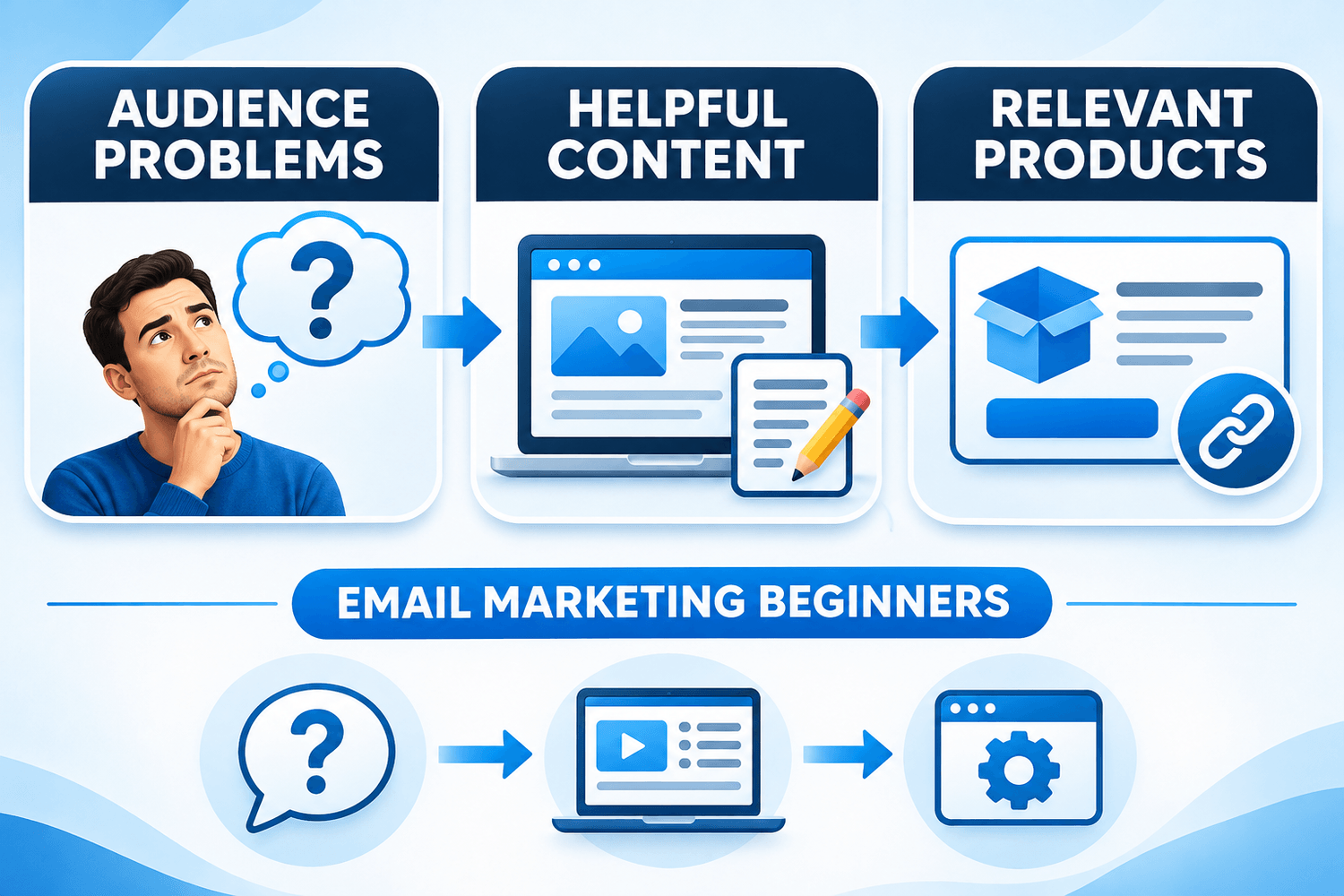
- People have recognizable questions or problems.
- You can create useful content addressing those problems.
- Relevant products or services exist that could help.
For example, consider the niche email marketing for beginners.
Potential readers might ask:
- How do I collect email subscribers without a website?
- Which features should I look for in an autoresponder?
- How do I write my first welcome email?
Each question could become a helpful article.
Relevant software recommendations could fit naturally where they genuinely help answer the question.
That doesn't automatically make the niche profitable. You still need to evaluate demand, competition, product quality, and your ability to reach interested readers.
Understand What Your Ideal Visitor Is Searching For
Not everyone searching online wants the same thing.
Some people want to learn. Others are comparing products. Some are nearly ready to purchase.
These differences are called search intent.
For example:
| Search Query | Likely Intent |
|---|---|
| What is email marketing? | Learn a concept |
| How to build an email list | Solve a problem |
| Email marketing tool A vs. tool B | Compare solutions |
| Email marketing software pricing | Evaluate a purchase |
A useful affiliate website can address several stages of this process.
Educational articles help readers understand their problems. Tutorials demonstrate possible solutions. Comparisons help readers evaluate their options.
This approach is more sustainable than publishing nothing but promotional pages.
Match Affiliate Products to Your Audience's Needs
Once you understand your audience, look for products that fit the problems you're addressing.
A beginner who wants to create a simple email list probably doesn't need an expensive enterprise marketing platform.
They may benefit more from a straightforward tool with accessible features and clear documentation.
Before recommending anything, consider whether the product is suitable for the intended reader, what limitations it has, and whether you can accurately explain its features.
A larger commission isn't automatically a good reason to promote a product.
Trust becomes easier to build when recommendations are relevant, balanced, and transparent.
Find Affiliate Programs That Accept Beginners
Choosing a niche gives you direction. The next step is finding programs that offer suitable products.
You don't need to join every affiliate program you discover.
Start by investigating a few opportunities that closely match your intended content.
Where to Find Relevant Affiliate Programs
There are two common ways to find affiliate opportunities.
Direct affiliate programs are offered by individual businesses. You apply through the company's website or designated partner portal.
Affiliate networks connect publishers with participating merchants. A network may provide access to multiple programs, although individual advertisers can have separate approval requirements.
You can discover opportunities by researching businesses that sell relevant products and checking whether they offer affiliate partnerships.
For example, someone creating tutorials about email marketing might investigate software companies that serve beginners.
Before applying, review what the company sells, who its customers are, and whether its products genuinely fit your audience.
What to Check Before Joining
A program's commission rate is only one consideration.
Use this checklist when evaluating an opportunity:
- Eligibility: Does the program accept new publishers or applicants without substantial traffic?
- Product relevance: Does the offer solve a problem your audience actually has?
- Commission terms: What qualifying actions generate commissions?
- Tracking rules: How are referrals attributed, and what tracking period applies?
- Payment conditions: Are there minimum balances, schedules, or other requirements?
- Promotion restrictions: Are websites, email marketing, social media, or other channels permitted?
- Product credibility: Can you support your recommendation with reliable information?
Also investigate refund policies and whether commissions can be reversed.
Terms differ between programs and can change, so always rely on current official documentation before making a decision.
What to Do if a Program Requires an Existing Audience
Don't assume rejection means affiliate marketing isn't an option.
Some programs want to review your website, publishing history, or promotional methods before accepting you.
If you don't qualify yet, concentrate on creating a useful publishing presence.
You could begin with a focused website containing educational articles, practical tutorials, and transparent information about its purpose.
As your content develops, you may become better positioned to apply to programs that require an established presence.
Meanwhile, investigate other programs whose published eligibility requirements fit your circumstances.
The important thing is to avoid misrepresenting your traffic, experience, or promotional methods on an application.
Choose One Traffic Source You Can Build Consistently
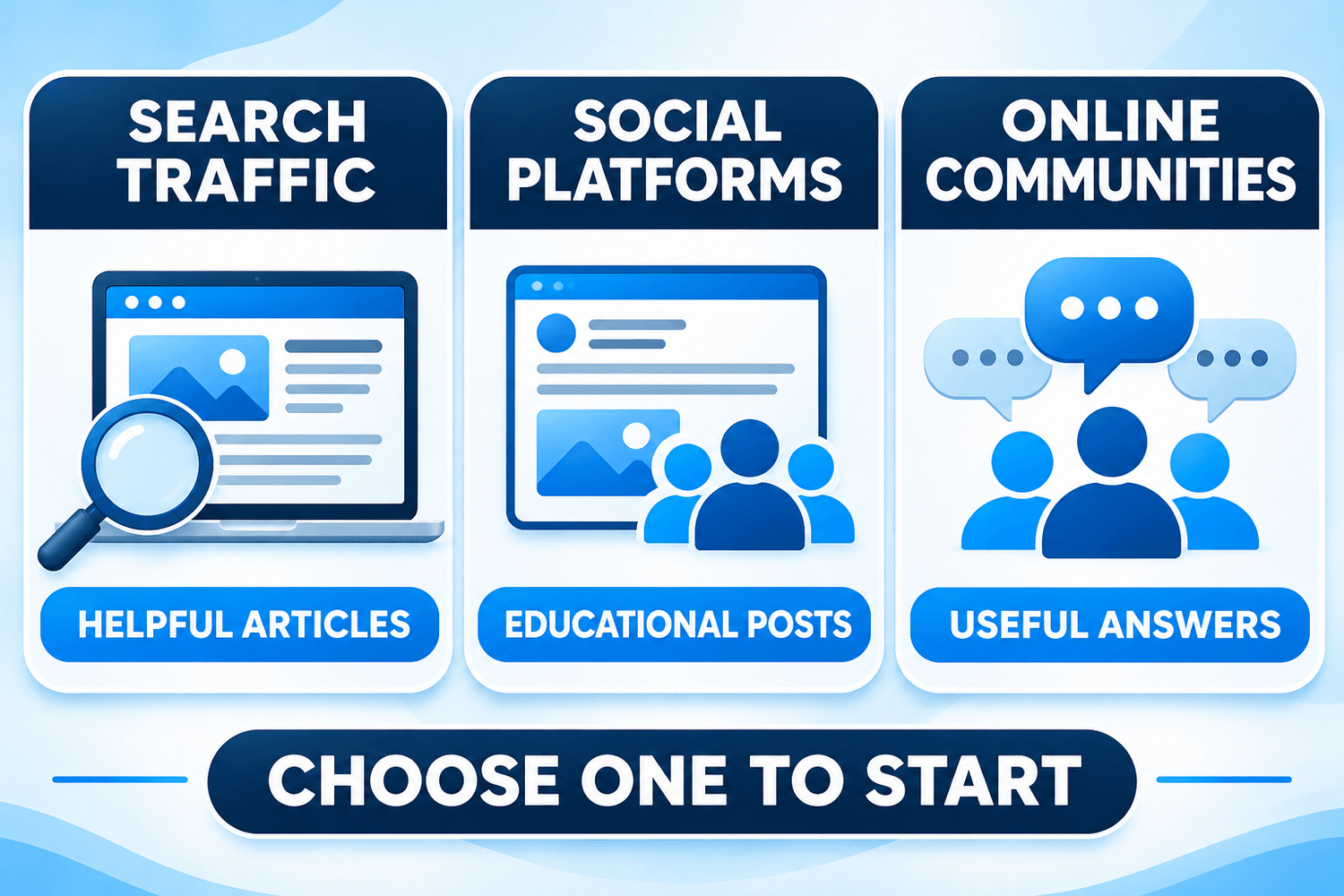
Once you know what you're writing about, you need a way for people to discover it.
There are several approaches, but beginners often make progress more manageable by concentrating on one primary traffic source.
You can expand later when you understand what is working.
Search Engine Traffic Through Helpful Articles
Search engine traffic comes from people discovering your content through searches on platforms such as Google.
For example, someone might search for:
"How to build an email list without a website"
If you've written a helpful article addressing that question, your page may have an opportunity to appear in relevant search results.
This approach usually involves:
- Researching questions your audience asks.
- Creating detailed, useful answers.
- Organizing content with clear headings.
- Making your website accessible to search engines.
- Improving articles as you learn more.
Search engine optimization, or SEO, helps make content understandable and discoverable.
However, Google does not guarantee that it will crawl, index, or display a page, even when the page follows its technical requirements. Its How Search Works documentation explains these distinctions.
Organic search can be a worthwhile long-term approach, but it requires patience and consistent effort.
Social Platforms Without an Existing Following
Social platforms can help distribute useful content even when you're starting with very few followers.
You might publish short educational posts, answer relevant questions, or share practical examples.
For instance, someone writing about beginner email marketing could explain one common mistake and direct interested readers toward a more detailed resource where appropriate.
The key is providing value rather than turning every post into a promotion.
Social distribution may require regular participation, and reach can fluctuate.
You also need to follow each platform's current policies concerning affiliate links, promotional content, and disclosures.
Communities and Question-Based Platforms
Online communities can reveal what your target audience struggles with.
Forums, discussion groups, and question-based websites often contain detailed conversations about real problems.
Participating can help you understand your readers and identify useful content ideas.
However, communities aren't free advertising spaces.
Some prohibit affiliate links entirely. Others restrict self-promotion or require moderators' permission.
A sensible approach is to contribute helpful answers without expecting every interaction to generate traffic.
If sharing a relevant article is allowed, it should genuinely add value to the discussion.
For most beginners, choosing one channel they can maintain consistently is more practical than trying to master everything immediately.
Create Content That Attracts the Right Visitors
Having a traffic source is only part of the process.
You also need content that gives people a reason to visit, read, and trust your recommendations.
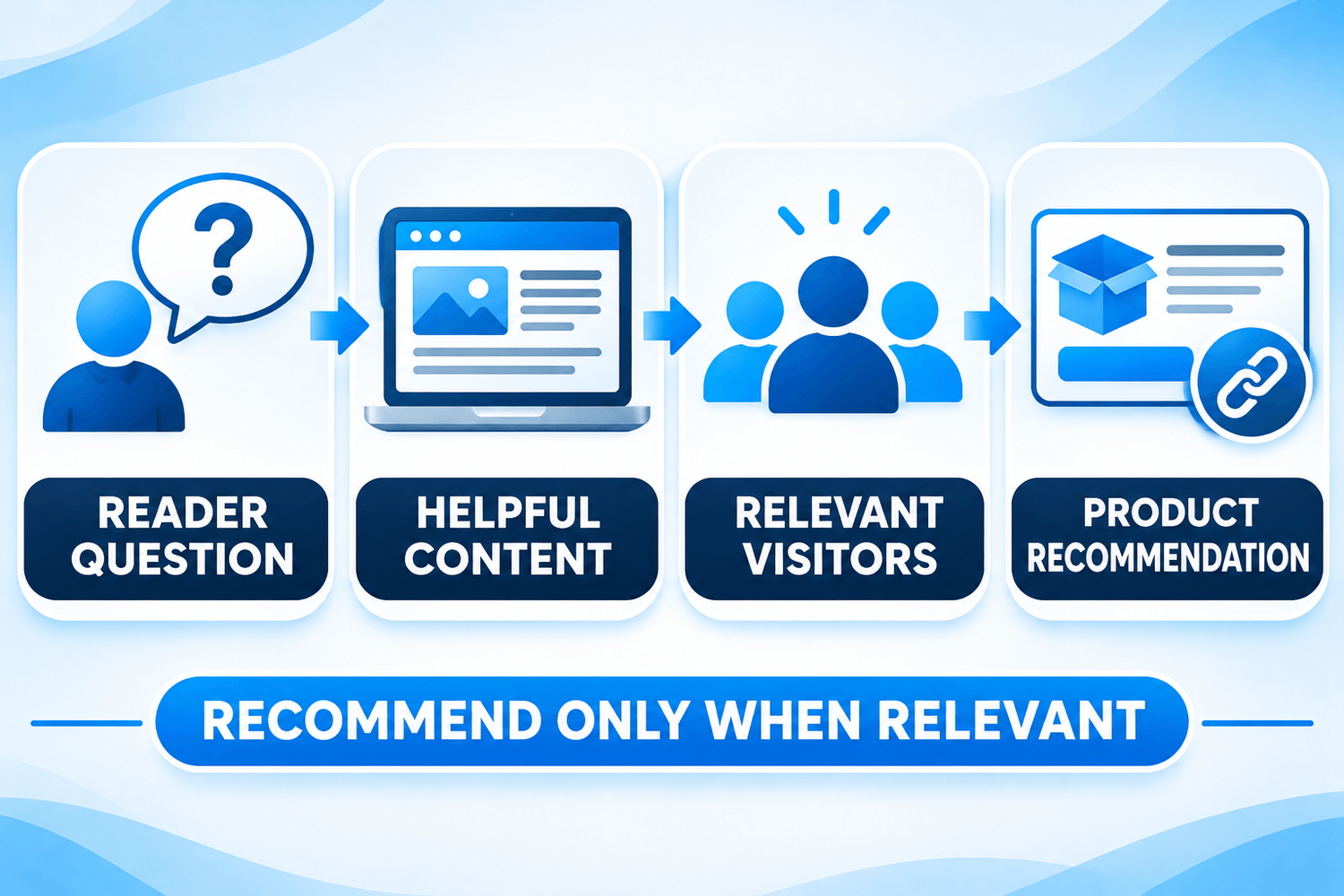
Good affiliate content begins with the reader's question, not the commission you hope to earn.
Find Questions Beginners Are Already Asking
Start by identifying specific problems within your niche.
You can explore search suggestions, related searches, relevant discussion threads, and questions people repeatedly ask.
For example, a broad topic such as "email marketing" might lead to more focused questions:
- How do I write my first welcome email?
- What should I include in an email signup form?
- How do I organize a small email list?
These are potential content topics, not verified high-volume keywords.
Before choosing one, examine the question's intent and consider whether you can provide an answer that is genuinely useful.
A focused article addressing one recognizable problem may serve readers better than a broad article that briefly mentions dozens of unrelated subjects.
Create Helpful Tutorials, Comparisons, and Reviews
Different article formats serve different reader needs.
Tutorials explain how to complete a task. They work well for readers looking for practical instructions.
Comparisons help people understand differences between potential solutions.
Reviews examine a particular product, including relevant features, strengths, limitations, and suitability.
Here's a simple example.
Suppose your niche is email marketing for beginners, and you identify the question:
"How do I create my first email welcome sequence?"
You could write a tutorial explaining what a welcome sequence does, how to plan its messages, and how to organize them inside an email marketing platform.
If a relevant tool genuinely helps with the process, you could explain which features to look for.
A separate comparison article could then help readers evaluate suitable platforms.
This creates a natural connection between educational content and potential product recommendations.
Place Affiliate Recommendations Naturally
An affiliate recommendation should make sense within the surrounding content.
If you're explaining how to create a welcome email, a relevant email marketing tool might be useful.
An unrelated hosting product or business opportunity probably wouldn't help answer that particular question.
Explain why a product may be suitable, who might benefit from it, and what limitations readers should consider.
Don't claim to have tested a product unless you actually have.
You must also clearly disclose affiliate relationships when appropriate.
For U.S. audiences, the FTC's Endorsement Guides explain that commission relationships should be disclosed clearly and conspicuously, close enough to recommendations for readers to understand the connection.
Federal Trade Commission
An understandable disclosure might say:
I may earn a commission if you purchase through links in this article.
Use a disclosure that accurately describes your relationship and is appropriately placed.
Build Your First Traffic Without Paid Advertising
Publishing an article doesn't automatically mean people will discover it.
A traffic-first strategy includes creating useful content, helping people find it, and learning from what happens afterward.
You don't need a paid advertising budget to begin these activities.
Publish Content Around Specific Search Questions
Choose a manageable publishing schedule and concentrate on answering relevant questions thoroughly.
For example, a beginner could develop a small collection of related articles about starting an email list.
One article might explain the basics. Another could cover signup forms. A third might discuss welcome emails.
These articles can support one another because they address connected reader problems.
Where appropriate, link between relevant pages to help visitors explore the subject.
Make each article useful on its own, rather than creating thin pages designed only to send readers elsewhere.
Also ensure your website can be accessed by visitors and search engines.
Google explains that a page must meet certain technical conditions to be eligible for indexing, but eligibility does not guarantee inclusion in search results.
Share Helpful Content Where It Is Relevant
After publishing, look for appropriate opportunities to introduce your content to interested readers.
You might share an article through an established social profile, contribute to a relevant discussion, or reference it when answering a question where links are permitted.
The goal isn't to place your URL in as many locations as possible.
It's to connect genuinely useful information with people who may benefit from it.
For example, if someone asks how to organize their first email sequence, a relevant tutorial could help.
A generic promotional message would be less useful.
Always respect community rules and avoid unsolicited mass promotion.
Improve Content Based on Early Feedback
New articles may receive little attention initially.
Instead of immediately abandoning a topic, examine what you can improve.
Ask yourself:
- Does the article answer the main question early?
- Are the instructions clear enough for a beginner?
- Does it include practical examples?
- Is the title an accurate description of the content?
- Are important reader questions missing?
- Is the page accessible and easy to navigate?
If readers ask the same follow-up question repeatedly, that may indicate an opportunity to clarify your article.
You can also improve examples, update outdated information, and connect related pages.
Not every improvement will increase traffic, but each should make the content more useful.
Track Your Progress Before Expecting Affiliate Sales
Once you've published some content, start paying attention to what happens.
You don't need complicated reports to begin understanding your progress.
You simply need to recognize what different measurements mean.
Understand Impressions, Clicks, and Affiliate Conversions
Several metrics can help you evaluate your efforts.
| Metric | What It Tells You |
|---|---|
| Search impressions | How often your content appeared in eligible search results |
| Search clicks | How often someone clicked through from search results |
| Website visits | How much traffic your website received, as measured by your analytics setup |
| Affiliate-link clicks | How often tracked affiliate links were clicked |
| Affiliate conversions | Qualifying actions attributed by the affiliate program |
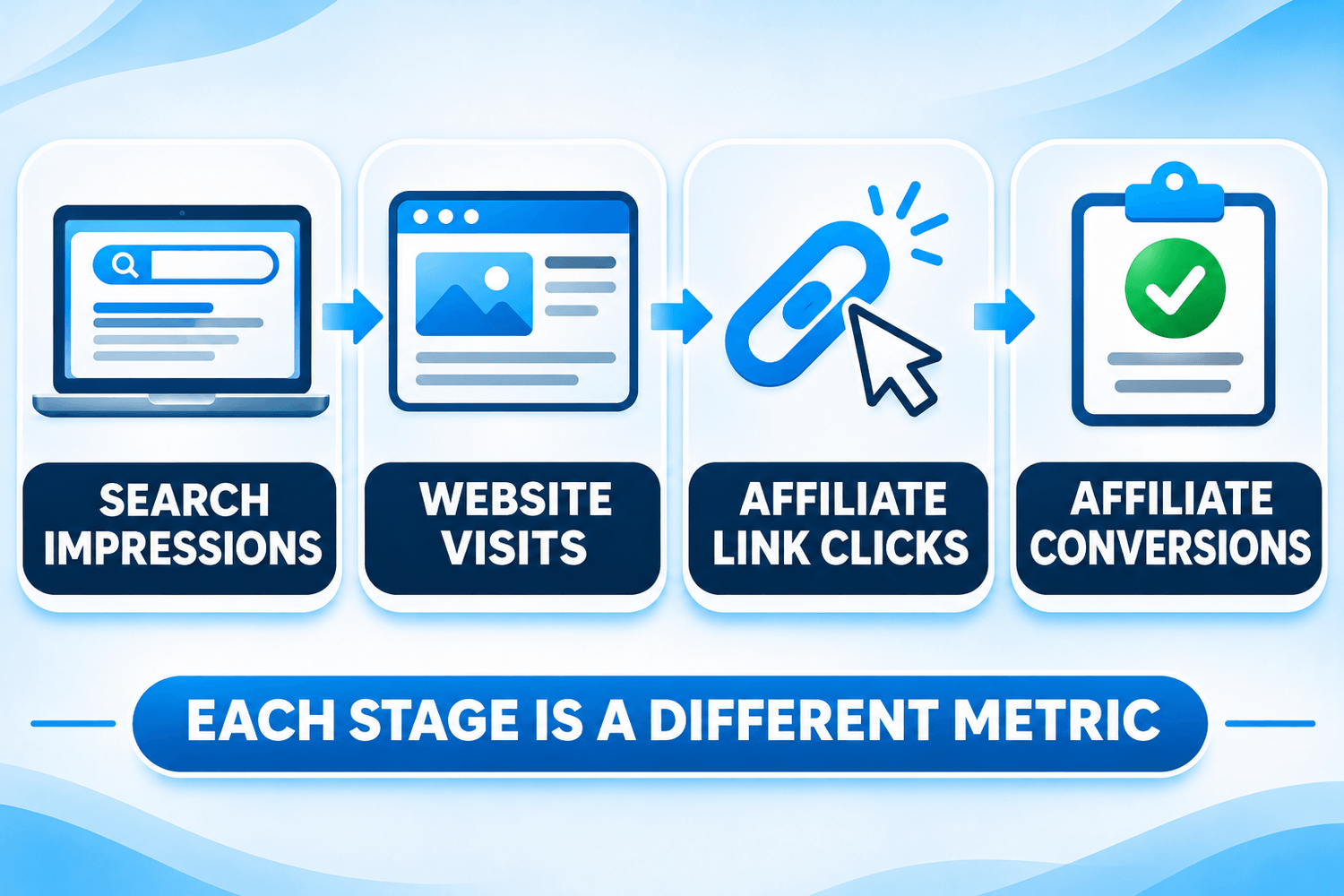
These measurements represent different stages of the visitor journey.
An impression isn't necessarily a website visit.
A website visit isn't necessarily an affiliate-link click.
And an affiliate-link click doesn't guarantee a commission.
Google Search Console and website analytics tools can help you understand different aspects of this process. Google's search performance guidance explains how impressions and clicks can help diagnose changes in search traffic.
Identify Which Content Attracts Relevant Visitors
As your website develops, look for patterns.
Perhaps an article about welcome emails attracts visitors while a broader article about online business receives little attention.
That doesn't automatically mean the second article is bad.
It may indicate differences in search demand, competition, discoverability, or how closely the content matches what people want.
Look beyond total visits.
Consider which questions bring people to your website and whether your articles answer those questions effectively.
If your affiliate dashboard provides referral data, examine whether relevant content is generating interest in suitable offers.
The purpose is to understand your audience, not to chase impressive-looking numbers.
Make Small Improvements Based on Real Data
Use a simple diagnostic process.
If your articles receive no search impressions: Check whether the pages are accessible, eligible for indexing, and actually indexed. Also consider whether their topics match recognizable search questions.
If articles receive impressions but few clicks: Review whether their titles and descriptions clearly communicate what readers will find.
If visitors arrive but rarely click affiliate links: Examine whether the recommendations are relevant, understandable, and placed where they genuinely help.
If affiliate links receive clicks but no reported conversions: Reconsider offer suitability and the expectations created by your content. Also review the program's attribution rules and reporting limitations.
These are possible explanations, not automatic diagnoses.
Make one meaningful improvement at a time and allow enough time to evaluate the results.
Your First 30 Days of Traffic-First Affiliate Marketing
A simple action plan can make the process less overwhelming.
The following 30-day schedule focuses on activities you can control rather than promising a certain number of visitors or commissions.
Week 1: Choose Your Niche and Traffic Channel
Begin by deciding which audience you want to help.
Identify common problems within your niche and research relevant products or services.
Then choose one primary traffic source.
For example, you might decide to create a beginner-focused website using organic search as your main discovery channel.
During this first week, aim to:
- Define your niche and ideal reader.
- Identify several recurring reader questions.
- Research a small number of relevant affiliate programs.
- Choose your primary traffic channel.
- Organize your initial content ideas.
You don't need to have everything figured out before moving forward.
You need enough direction to begin creating useful material.
Week 2: Research and Create Your First Content
Choose a specific question from your topic list.
Research the subject carefully, then develop an article that answers it thoroughly.
Use a clear title, descriptive headings, practical instructions, and relevant examples.
Where a product recommendation makes sense, explain its relevance and limitations. Include appropriate affiliate disclosures if you use commission-generating links.
If you're still waiting for affiliate program approval, you can publish educational content without promotional links.
Your main objective is to create something that would help a reader even if they never purchase anything.
Weeks 3–4: Publish, Share, and Review Progress
Continue publishing at a pace you can maintain.
You might add another tutorial, develop a comparison, or answer a related question that emerged during your research.
Share your content through appropriate channels without spamming communities or ignoring platform rules.
If you have a website, set up suitable analytics and search performance tools.
Review whether your pages are accessible, whether search engines have discovered them, and whether visitors are beginning to interact with your content.
At the end of the month, ask:
- Did I establish a clear niche and publishing direction?
- Did I create content that answers real questions?
- Did I choose a traffic source I can continue using?
- Did I learn anything about what readers need?
- What should I improve or publish next?
You might not have meaningful traffic or affiliate sales yet. That's not evidence that the entire approach has failed.
The purpose of this first month is to establish a useful foundation and a repeatable process.
Frequently Asked Questions
Do You Need Followers to Start Affiliate Marketing?
No. You can begin learning affiliate marketing and creating content without social media followers. However, you eventually need to reach relevant people for your recommendations to have a chance of generating commissions.
Can You Start Affiliate Marketing Without a Website?
Yes. Some affiliate programs allow promotion through approved social platforms, email channels, or other publishing methods. Requirements vary, so check each program's rules before applying or sharing links.
How Long Does It Take to Get Traffic for Affiliate Marketing?
There is no universal timeframe. Results depend on factors such as your niche, content quality, competition, distribution methods, and consistency. Organic search traffic may develop gradually, and some content may never attract significant visits.
Can You Join Affiliate Programs With No Visitors?
Some programs may accept new publishers without established traffic, while others require an active website or other qualifications. Review the official eligibility requirements rather than assuming every program follows the same rules.
Should Beginners Focus on Traffic or Affiliate Sales First?
Beginners should focus on understanding their audience, creating useful content, and developing a way to attract relevant visitors. Affiliate sales are a potential result of that process, not something you can guarantee simply by publishing links.
Products / Tools / Resources
- Google Search Console: A free Google service for monitoring your website's presence in Google Search, including search performance and indexing information.
- Google Analytics: A website analytics service that can help you understand visitor activity when configured appropriately.
- Google Search Central: Official documentation covering how Google Search works, technical requirements, and guidance for website owners.
- FTC Endorsement Guides: Official U.S. guidance explaining advertising disclosures and responsibilities when endorsing products or services.
- Affiliate Program Documentation: The official terms, eligibility rules, commission policies, and promotional restrictions for any affiliate program you're considering.
The most useful next step is to choose one reader problem, create a genuinely helpful piece of content around it, and begin developing a consistent way for interested people to discover your work.
Want a practical resource for learning how to generate leads online? Explore the report for an introduction to the methods and skills involved.

WRITTEN BY
Tom Kimpton
Founder, Marketing With Tom
Tom Kimpton is the founder of Marketing With Tom, where he shares practical strategies for affiliate marketing, traffic generation, email list building, and making money online. He focuses on testing tools and strategies firsthand and sharing what he learns to help beginners build their online business.
READY FOR THE NEXT STEP?
Build Your Traffic and Email List With the Tools I Use
I’ve put together the resources I use and recommend for generating
traffic, building an email list, and growing an online business.
If you’re looking for a simple place to start, this is it.

Practical strategies for building traffic, growing an email list, and creating an online marketing business.
Start Here
New to online marketing?
Start with practical guides for generating traffic, building your email list, and creating a simple marketing system.
© 2026 Marketing With Tom. All rights reserved.