
How to Build Trust as a New Affiliate Marketer: 7 Ways to Earn Credibility
Starting affiliate marketing can feel uncomfortable when nobody knows who you are.
You might find a product that could genuinely help someone, but then a question comes to mind: Why would anyone trust my recommendation?
You don't have an established reputation. You may not have made your first affiliate sale. Perhaps you haven't even built an audience yet.
The good news is that you don't need to pretend to be an expert to start earning credibility.
Learning how to build trust as a new affiliate marketer comes down to making honest recommendations, providing useful information, and treating readers like people rather than potential commissions.
There are practical ways to begin doing that, even when you're starting from scratch.
Why Trust Matters When You Are New to Affiliate Marketing
Affiliate marketing involves recommending products or services and potentially earning a commission when someone takes a qualifying action through your referral.
That financial relationship makes transparency particularly important.
Why Readers May Question Affiliate Recommendations
Imagine searching for an email marketing platform.
You discover an article claiming that one particular service is perfect for everyone. The writer mentions nothing about its limitations, pricing restrictions, or possible alternatives.
Every paragraph seems designed to persuade you to click an affiliate link.
Would you feel confident following that recommendation?
Probably not.
Readers may reasonably wonder whether an affiliate recommends something because it meets their needs or because the affiliate receives compensation.
Your responsibility is to give them enough useful, accurate information to make their own decisions.
Why Credibility Matters More Than Looking Successful
New affiliates sometimes feel pressured to demonstrate impressive earnings, large audiences, or extensive experience.
But appearing successful isn't the same as being trustworthy.
A beginner who carefully researches a product, explains its limitations, and admits what they haven't tested can provide more useful information than someone making exaggerated claims.
You don't need income screenshots or dramatic success stories to explain how a product works.
You need to be accurate about what you know and transparent about what you don't.
How Trust Develops Through Consistent, Helpful Actions
Credibility isn't something you establish with a single sentence on your website.
It develops through the decisions you make repeatedly.
Are your recommendations relevant? Do you correct outdated information? Can readers understand your affiliate relationships? Do you answer questions honestly?
These behaviors give people reasons to take your content seriously.
If you're still learning the fundamentals, this guide to affiliate marketing for beginners with no experience provides additional background on getting started.
Here are seven practical ways to begin establishing credibility.

1. Be Honest About Your Experience and What You Know
Honesty is one of the simplest trust-building practices available to beginners.
You don't need years of experience to explain something useful. However, you should never suggest you've achieved results or tested products when you haven't.
Share What You Have Actually Learned
Suppose you're researching email marketing software.
You've studied its features, watched demonstrations, and reviewed the company's documentation, but you haven't used the service yourself.
You can still create useful educational content explaining what your research revealed.
For example:
"Based on the company's published documentation, this platform offers email automation and subscriber management features. I haven't personally tested its deliverability or customer support."
That explanation gives readers valuable context.
You aren't pretending to know more than you do.
As your knowledge develops, you can update your content with additional findings or genuine firsthand experience.
Separate Personal Experience From Research
Readers should understand where your information comes from.
Consider these distinctions:
- Firsthand experience: Something you personally used, observed, or tested.
- Documented information: Details supported by official instructions, product documentation, or other credible sources.
- Personal interpretation: Your reasoned opinion based on available information.
These categories aren't interchangeable.
For instance, reading positive customer reviews doesn't justify claiming that you personally received excellent customer support.
Likewise, watching a demonstration doesn't establish that you've successfully used the product yourself.
Clear distinctions make your recommendations easier to evaluate.
Avoid Pretending to Have Results You Cannot Prove
Income claims are particularly sensitive in the make-money-online niche.
Statements suggesting that beginners can easily earn hundreds of dollars every day may create unrealistic expectations.
Avoid inventing earnings, customer testimonials, conversion results, or product experiences.
If you don't have personal results to share, focus on explaining the process.
A useful beginner credibility checklist is straightforward:
- Describe your actual level of experience.
- Identify the sources behind important claims.
- Separate research from personal testing.
- Avoid invented success stories.
- Correct information when you discover an error.
Being new doesn't prevent you from being helpful. Misrepresenting your experience is the problem.
2. Recommend Products That Genuinely Fit Your Audience
An affiliate product should solve a relevant problem for the people reading your content.
That principle sounds obvious, but it becomes harder to follow when a product offers an attractive commission.
Understand What Your Audience Actually Needs
Start by identifying the reader's situation.
A complete beginner interested in email marketing may need an affordable platform with straightforward setup instructions.
An established business managing complex customer journeys may need advanced segmentation and integrations.
Those readers don't necessarily need the same recommendation.
Before selecting a product, consider:
- What problem is the reader trying to solve?
- How much experience do they have?
- What is their likely budget?
- Which features are genuinely necessary?
- What difficulties might they encounter?
The better you understand the reader's circumstances, the easier it becomes to evaluate suitable options.
Research Products Before Recommending Them
Don't choose an affiliate offer solely because its commission looks attractive.
Research the product itself.
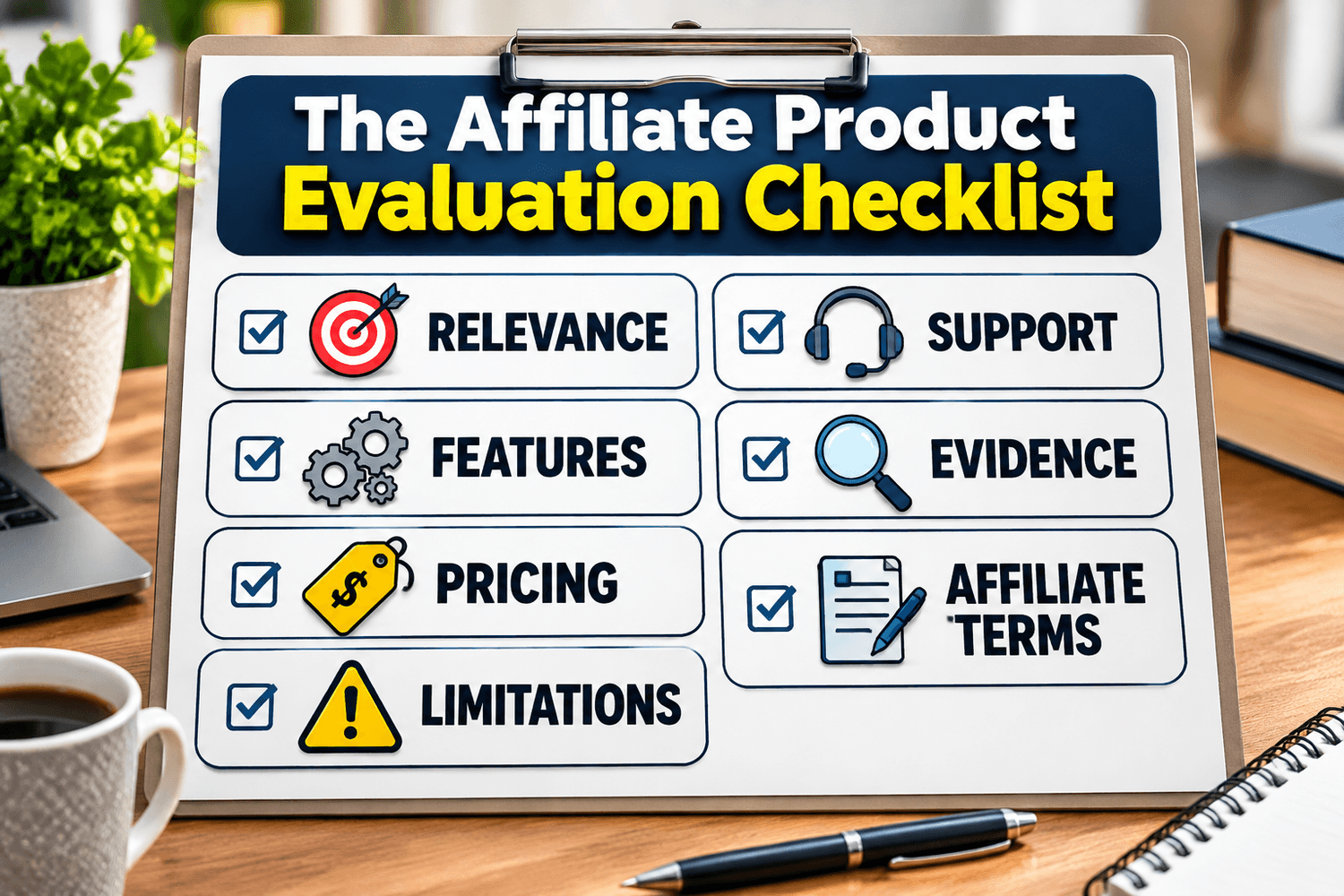
A practical evaluation checklist might include:
| Evaluation Area | Question to Ask |
|---|---|
| Relevance | Does this solve the reader's problem? |
| Features | Does it provide the necessary capabilities? |
| Pricing | What does the customer actually pay? |
| Limitations | What restrictions should readers understand? |
| Support | What assistance is documented or available? |
| Evidence | Can important product claims be verified? |
| Affiliate terms | Are the proposed promotional methods permitted? |
If you haven't used the product, be transparent about that limitation.
Research is useful, but it shouldn't be presented as firsthand testing.
Explain Who a Product Is and Is Not Right For
A recommendation becomes more useful when readers understand its boundaries.
For example, a beginner-friendly email platform might be suitable for someone building a small newsletter but less appropriate for a company requiring sophisticated automation.
Explaining both situations helps readers make informed choices.
You can also acknowledge when a free alternative might meet someone's needs.
The objective isn't to persuade everyone to purchase the same product.
It's to help the right reader identify a suitable solution.
3. Create Helpful Content Before Asking for a Sale
One of the most practical ways to establish credibility is to publish information that helps people before asking them to buy anything.
Your content should have value even when nobody clicks an affiliate link.
Answer Real Beginner Questions
Think about the questions people ask when they're unfamiliar with your niche.
Someone exploring affiliate marketing might wonder:
- How do affiliate links work?
- Do I need a website?
- How do I choose products to promote?
- Can I start without an audience?
- What should I disclose when recommending something?
Each question represents an opportunity to explain something useful.
Instead of trying to cover everything in one article, choose a specific problem and answer it thoroughly.
A clear explanation of one difficult beginner concept may be more useful than a long article filled with vague advice.
Use Tutorials, Comparisons, and Practical Examples
Different questions call for different content formats.
A tutorial can walk readers through a process.
A comparison can explain meaningful differences between two products.
A checklist can help someone evaluate options independently.
Consider these two approaches to promoting an email marketing platform.
Sales-heavy approach:
"This is the best email marketing platform. Sign up now and start making money."
Helpful approach:
"Before choosing an email marketing platform, compare its subscriber limits, automation features, pricing, and ease of use. The right choice depends on your needs and budget."
The second approach gives readers information they can use.
It also creates a natural opportunity to discuss a relevant product without forcing a recommendation.
Make Your Content Useful Even Without an Affiliate Click
Ask yourself a simple question before publishing:
Would someone still benefit from this article if they never purchased anything?
If the answer is no, consider adding more practical value.
You might explain a process, identify common mistakes, provide a decision-making checklist, or clarify confusing terminology.
Google's guidance on creating helpful, reliable, people-first content emphasizes creating material that benefits readers rather than content primarily intended to manipulate search rankings.
That doesn't mean helpful content guarantees search visibility.
It means usefulness should be a central editorial objective.
When you consistently answer real questions, your content provides readers with reasons to return.
4. Disclose Affiliate Relationships Clearly
Affiliate disclosures shouldn't be treated as inconvenient legal text that readers are expected to overlook.
They explain an important part of your relationship with the products you recommend.
Explain When You May Earn a Commission
When you recommend a product and may receive compensation through a referral link, readers should understand that relationship.
For example:
"I may earn a commission if you purchase through links in this article."
This is an illustrative disclosure, not a universal legal template.
The appropriate wording depends on the actual relationship and how the endorsement appears.
The Federal Trade Commission's Endorsement Guides FAQ explains that affiliate marketers should clearly and conspicuously disclose relevant commission relationships.
Transparency helps readers evaluate recommendations with appropriate context.
Place Disclosures Where Readers Can Notice Them
A disclosure isn't particularly useful if readers never see it.
The FTC explains that disclosures should be clear and conspicuous, with placement close enough to the relevant recommendation that readers understand the connection.
Depending on the article's layout, that may mean placing a disclosure near the beginning of a review or alongside relevant recommendations.
A general affiliate disclosure page can provide additional information about your website's practices.
However, don't assume that a disclosure buried in a footer or separate policy page adequately explains every affiliate recommendation.
Consider how readers encounter your content on both desktop and mobile devices.

Use Plain Language Instead of Confusing Disclaimers
Readers shouldn't need to understand industry jargon to recognize that you may receive compensation.
A label such as "affiliate link" may not communicate that relationship clearly to everyone.
Plain language explaining that you earn or may earn a commission is easier to understand.
Avoid burying disclosures inside unrelated paragraphs or surrounding them with complicated wording.
Also check the requirements of the affiliate programs you participate in.
Different programs and promotional channels may impose additional conditions.
A clear disclosure is part of responsible affiliate marketing, but it doesn't excuse misleading product claims.
5. Explain Product Benefits and Limitations Honestly
Trustworthy recommendations don't require you to criticize every product.
They do require you to describe products fairly.
Describe Benefits Without Exaggerating Results
It's reasonable to explain that an email marketing platform includes automation tools or that a website builder provides templates.
Those are product capabilities that can be verified.
It's different to claim that using the same tools will automatically generate sales or replace someone's income.
A feature is not a guaranteed outcome.
Instead of promising that a product will make someone successful, explain what it does and how it might help under suitable circumstances.
For example:
"Email automation can help organize follow-up messages, but building an engaged subscriber list still requires relevant content and consistent effort."
This gives readers a more realistic understanding of the tool.
Acknowledge Costs, Drawbacks, and Learning Curves
Every product has limitations.
Some tools become more expensive as usage increases. Others require technical setup, have restricted free plans, or lack particular features.
When these limitations are relevant, explain them.
A balanced recommendation might say:
"This platform may suit beginners who want a straightforward starting point, but users requiring advanced integrations should compare its capabilities carefully."
That doesn't make the recommendation weak.
It makes the recommendation more useful.
Readers can decide whether the limitations matter to their situation.
Avoid Unrealistic Income and Success Claims
Affiliate marketing attracts people hoping to improve their financial circumstances.
That makes realistic communication especially important.
Avoid statements implying that success is automatic, effortless, or available within a guaranteed timeframe.
Compare these examples.
Exaggerated:
"Use this system and start earning $100 every day without experience."
Balanced:
"This resource introduces a method for learning affiliate marketing. Results depend on factors such as implementation, audience relevance, and the effectiveness of your marketing efforts."
The second statement describes the opportunity without promising an outcome.
Even when you have genuine results, they shouldn't automatically be presented as typical of what others can expect.
The FTC's endorsement guidance addresses misleading representations and the need for appropriate substantiation.
Your job is to help readers understand what they're considering, not convince them that success is certain.
6. Build Credibility Through Consistency and Reliability
Trust-building doesn't end when you publish an article.
Information changes, products evolve, and recommendations occasionally need correction.
Keep Your Content Accurate and Up to Date
Suppose you recommend a product because it offers a particular feature on its free plan.
Several months later, the company changes that plan.
Your original article may now give readers the wrong impression.
Reviewing important product information helps reduce that risk.
You don't need to rewrite everything constantly.
Instead, prioritize content containing details likely to change, including pricing, plan limits, product features, and program conditions.
A manageable monthly review might involve checking your most important articles and updating anything that is no longer accurate.
Maintain Consistent Standards Across Your Recommendations
Readers should be able to recognize how you evaluate products.
If affordability matters when reviewing one email platform, it should remain a relevant consideration when reviewing another aimed at the same audience.
Consistent evaluation criteria make comparisons easier to understand.
You can establish simple editorial standards:
- Explain the intended audience.
- Verify important features.
- Identify meaningful limitations.
- Distinguish research from personal experience.
- Disclose affiliate relationships.
- Avoid unsupported performance claims.
These standards don't require publishing every day.
They require applying the same care whenever you publish.
Correct Mistakes and Be Transparent About Changes
Eventually, you may discover an error.
Perhaps a product feature was misunderstood, a price changed, or an affiliate program updated its terms.
Correct the information rather than leaving it in place because the original recommendation generates clicks.
For significant corrections, a short update note may help readers understand what changed.
For example:
"Updated to reflect changes to the product's available features."
Only use such a note when an actual update has occurred.
Accuracy matters more than pretending you've never made a mistake.
7. Earn Audience Confidence Through Genuine Engagement
Publishing helpful content is important, but credibility also depends on how you interact with people.
Even a small audience creates opportunities to demonstrate reliability.
Respond Honestly to Questions and Feedback
When someone asks a question, try to provide an answer that addresses their actual concern.
If you don't know, say so.
You can explain what you would need to research rather than inventing an answer.
For example, if someone asks whether a particular platform integrates with software you haven't investigated, avoid confidently claiming that it does.
Instead, direct them toward the relevant documentation or explain that the integration needs verification.
A useful answer doesn't always require immediate certainty.
Respect Reader Decisions and Avoid Pressure
Not everyone who reads your content will want to purchase something.
Some people are researching. Others may be comparing alternatives or waiting until they have a larger budget.
Respect those decisions.
Avoid repeatedly pressuring readers, creating fake scarcity, or implying that refusing an offer means missing a guaranteed opportunity.
Consider the difference.
Pushy response:
"You need to buy this now or you'll never succeed."
Helpful response:
"If you're comparing options, consider whether the features justify the cost for your current needs."
The helpful response gives readers room to make their own decisions.
Build Relationships Without Expecting Immediate Sales
You don't need hundreds of comments or thousands of followers to begin interacting meaningfully.
A thoughtful reply to one question can be worthwhile.
So can correcting a misunderstanding, acknowledging a useful suggestion, or recommending a free resource when it's appropriate.
These actions may not produce immediate affiliate commissions.
That's fine.
The purpose of genuine engagement is to help people and communicate responsibly.
When readers repeatedly encounter useful information and respectful behavior, they have more evidence on which to evaluate your credibility.
Start with one practical action: review your next affiliate recommendation and ask whether it is accurate, relevant, transparent, and genuinely useful to the person reading it.
Frequently Asked Questions
Can You Build Trust in Affiliate Marketing Without an Audience?
Yes. You can begin building credibility before developing a substantial audience by publishing accurate educational content, researching recommendations carefully, and being transparent about your experience.
You won't have an established reputation immediately, but you can establish responsible habits from the beginning.
Do You Need to Use Every Affiliate Product Before Recommending It?
Not necessarily. However, you must not imply that you've personally used or tested a product when you haven't.
Base recommendations on reliable information, explain the limits of your knowledge, and follow applicable affiliate program requirements. Some claims cannot responsibly be made without firsthand evidence.
How Long Does It Take to Build Trust as an Affiliate Marketer?
There is no universal timeline.
Credibility depends on factors such as the quality of your information, consistency, transparency, and how readers experience your recommendations.
Focus on maintaining trustworthy practices rather than expecting confidence or sales within a fixed number of days.
Can You Promote Affiliate Products Without Showing Your Face?
Yes. Educational websites, written tutorials, newsletters, and other content formats can communicate useful information without requiring personal photographs or videos.
However, remaining off-camera doesn't remove the need for accurate claims, honest representation, and appropriate affiliate disclosures.
What Should You Do if You Recommend a Product That Disappoints Your Audience?
Listen to the concern and determine whether your recommendation needs clarification or correction.
If you published inaccurate information, update it. If a product's limitations were insufficiently explained, improve the description.
Don't invent excuses or dismiss legitimate feedback. Taking responsibility is an important part of maintaining credibility.
Products / Tools / Resources
You don't need expensive tools to begin practicing the seven methods described here.
A few useful resources include:
- FTC Endorsement Guides: Guidance on endorsements, material connections, and affiliate disclosures.
- Google Search Central: Documentation on helpful content and responsible website publishing.
- Product Documentation: Official information for verifying features, pricing, and limitations before making recommendations.
- Content Review Checklist: A simple document for tracking article updates, corrections, and product information that needs rechecking.
The most useful starting point isn't a particular product. It's developing a repeatable process for making recommendations that readers can evaluate with confidence.
Want to Learn More About Building Your Online Marketing Skills?
Explore a beginner-friendly report introducing online marketing and lead-generation methods you can learn and evaluate at your own pace.
Take a look at the resource and decide whether it fits your goals.

WRITTEN BY
Tom Kimpton
Founder, Marketing With Tom
Tom Kimpton is the founder of Marketing With Tom, where he shares practical strategies for affiliate marketing, traffic generation, email list building, and making money online. He focuses on testing tools and strategies firsthand and sharing what he learns to help beginners build their online business.
READY FOR THE NEXT STEP?
Build Your Traffic and Email List With the Tools I Use
I’ve put together the resources I use and recommend for generating
traffic, building an email list, and growing an online business.
If you’re looking for a simple place to start, this is it.

Practical strategies for building traffic, growing an email list, and creating an online marketing business.
Start Here
New to online marketing?
Start with practical guides for generating traffic, building your email list, and creating a simple marketing system.
© 2026 Marketing With Tom. All rights reserved.