3. Create a Free Offer That Gives People a Reason to Subscribe
Once your signup system is ready, the next challenge is making your invitation appealing.
A lead magnet is a resource or benefit offered in connection with subscribing.
It doesn't have to be expensive or complicated. It needs to be useful to the people you're trying to reach.
Identify a Specific Problem Your Audience Wants to Solve
Start by thinking about the questions your audience repeatedly asks.
If you're targeting beginners interested in affiliate marketing, they might want to know how to choose an offer, find free traffic, or create their first signup page.
Choose one manageable problem rather than trying to solve everything at once.
For example:
Audience: New affiliate marketers.
Problem: They don't know what to do before promoting their first affiliate offer.
Possible solution: A beginner's preparation checklist.
A focused resource gives readers a clearer reason to subscribe than a vague promise of marketing tips.
Choose a Simple Lead Magnet You Can Create for Free
You don't need a lengthy ebook or professionally designed course.
Consider creating a practical resource such as:
- A one-page checklist.
- A short PDF guide.
- A planning worksheet.
- A reusable template.
- A beginner email lesson series.
Choose a format that fits the problem.
A checklist might work well for a task with several steps. A template could help someone complete a repetitive activity. A short guide may be more appropriate when explanations are necessary.
The quality of the information matters more than the number of pages.
Make sure the resource is accurate, easy to use, and delivers what your signup message promises.
Match Your Signup Offer to the Traffic Source
Imagine publishing content about free traffic generation.
Someone who discovers that content is probably interested in attracting visitors without advertising.
Offering a free traffic planning worksheet creates a logical connection between the content and the signup opportunity.
Now imagine offering that same visitor an unrelated guide about household budgeting.
Even if the budgeting guide is useful, it doesn't match the reason the visitor arrived.
This is why audience relevance matters.
Before sharing your signup link, ask whether the people visiting from that source are likely to care about the offer.
Write a Clear Signup Message Without Exaggerated Promises
Your signup message should explain the benefit without making claims you cannot support.
Instead of:
"Get Thousands of Subscribers Almost Overnight!"
Try:
"Get a Free Checklist for Planning Your First Email List."
The second message is specific, understandable, and realistic.
A helpful signup message usually answers three questions:
- What will I receive?
- How will it help me?
- What happens when I subscribe?
You don't need dramatic language to communicate value.
A clear offer that accurately describes the resource gives visitors enough information to make their own decision.
4. Find Free Traffic Sources That Can Attract Potential Subscribers
With your signup system and offer prepared, you can begin attracting potential subscribers.
There are several ways to generate traffic without purchasing advertising. The right choice depends on your audience, available time, and willingness to create useful content consistently.
Attract Interested Readers Through Helpful Blog Content
A blog gives you space to answer specific questions and explain topics in detail.
For example, an article about choosing a beginner affiliate program could introduce a relevant checklist that helps readers compare potential programs.
The content provides the initial value. The signup offer gives interested readers a way to continue learning.
Blogging can also support internal linking between related articles, helping visitors discover additional resources.
If you'd like a more focused explanation of this approach, read How to Get Email Subscribers From Blog Posts.
Remember that publishing an article doesn't guarantee traffic. Building useful content and earning search visibility can take time.
Use Search-Friendly Content to Reach People With Specific Questions
Search engines can help people discover articles that address their questions.
Instead of writing about a broad subject such as "email marketing," you might focus on a narrower question like "how to create a signup form without a website."
The narrower topic gives you an opportunity to answer a specific problem thoroughly.
Google's Search Central guidance emphasizes creating helpful, reliable content for people rather than producing pages primarily to manipulate rankings.
For beginners, that means writing clear answers, organizing information logically, and avoiding unnecessary keyword repetition.
Search traffic isn't immediate or guaranteed, but useful articles can remain available for discovery after publication.
Share Useful Content on Social Media Without Spamming
Social media offers another way to introduce people to your content.
You might share a practical tip, explain a common mistake, or summarize a useful lesson from an article.
For example, a post about three mistakes beginners make when creating lead magnets could direct interested readers to a more detailed guide.
The key is to contribute something useful before asking people to take another action.
Avoid posting the same promotional link repeatedly, sending unsolicited messages, or treating every conversation as a sales opportunity.
Choose a platform where your intended audience actually participates, and learn its current promotional rules.
Participate in Relevant Online Communities
Online communities can help you understand what your audience struggles with.
Discussion forums, professional groups, and topic-specific communities often contain questions that can inspire useful content.
You might answer a beginner's question about setting up an email form or explain how a simple lead magnet works.
When permitted, you can reference a relevant resource that expands on your answer.
However, some communities prohibit promotional links or require prior participation.
Respect those rules. Don't disguise advertising as independent advice.
Even when you cannot share a link, helpful participation can teach you which problems deserve better educational content.
Use Guest Content and Collaborations to Reach New Audiences
You can also introduce your work to people who already follow another creator or publication.
Guest articles, educational interviews, and collaborative resources are possible approaches.
For example, you might contribute an article about beginner email marketing to a website serving new online entrepreneurs.
If the publisher allows it, an appropriate author biography could direct interested readers to your own educational resource.
Focus on relevance and genuine contribution.
A collaboration with a smaller but closely related audience may be more useful than reaching a large audience with little interest in your topic.
5. Turn Free Traffic Into Email Signups
This is where the different parts of your strategy come together.
Attracting visitors creates an opportunity. Your signup experience determines whether interested people have a clear, voluntary way to join your list.
Give Visitors a Clear Next Step
When someone finishes reading useful content, they may want more information.
Give them an obvious next step that connects to what they've just learned.
For example, after an article about choosing free traffic sources, you could invite readers to get a traffic planning worksheet.
The invitation should explain what the resource contains and why it relates to the article.
Don't assume visitors will search your website for a signup form.
Make the opportunity easy to recognize without interrupting their reading experience unnecessarily.
Place Signup Opportunities Where They Make Sense
A signup invitation can appear within relevant content, near the end of an article, or on a dedicated landing page.
The best placement depends on the page and reader experience.
A contextual signup invitation can be useful after explaining a problem that the lead magnet helps solve.
An end-of-article invitation may suit readers who want to finish learning before deciding whether to subscribe.
On mobile devices, make sure forms are readable, easy to complete, and don't obstruct important content.
Rather than assuming one placement is universally best, start with a sensible location and review the results.
Connect Your Content to the Right Lead Magnet
The transition from content to signup offer should feel logical.
Consider this illustrative subscriber journey:
- A beginner searches for advice about generating free traffic.
- They discover a helpful article explaining several organic methods.
- The article introduces a free traffic planning checklist.
- The reader decides the checklist would help organize their next steps.
- They voluntarily subscribe and receive the resource.
Every stage has a purpose.
The article answers the initial question. The lead magnet provides additional practical value. The signup process lets the reader choose whether to continue.
This example illustrates a possible journey, not a guaranteed conversion sequence.
Reduce Unnecessary Friction in the Signup Process
A complicated signup process can make it harder for interested visitors to complete the action.
Ask only for information you genuinely need.
For many beginner newsletters, an email address may be sufficient. A first name can be optional if personalization would be useful.
Make the signup button clear, explain what happens next, and test the form yourself.
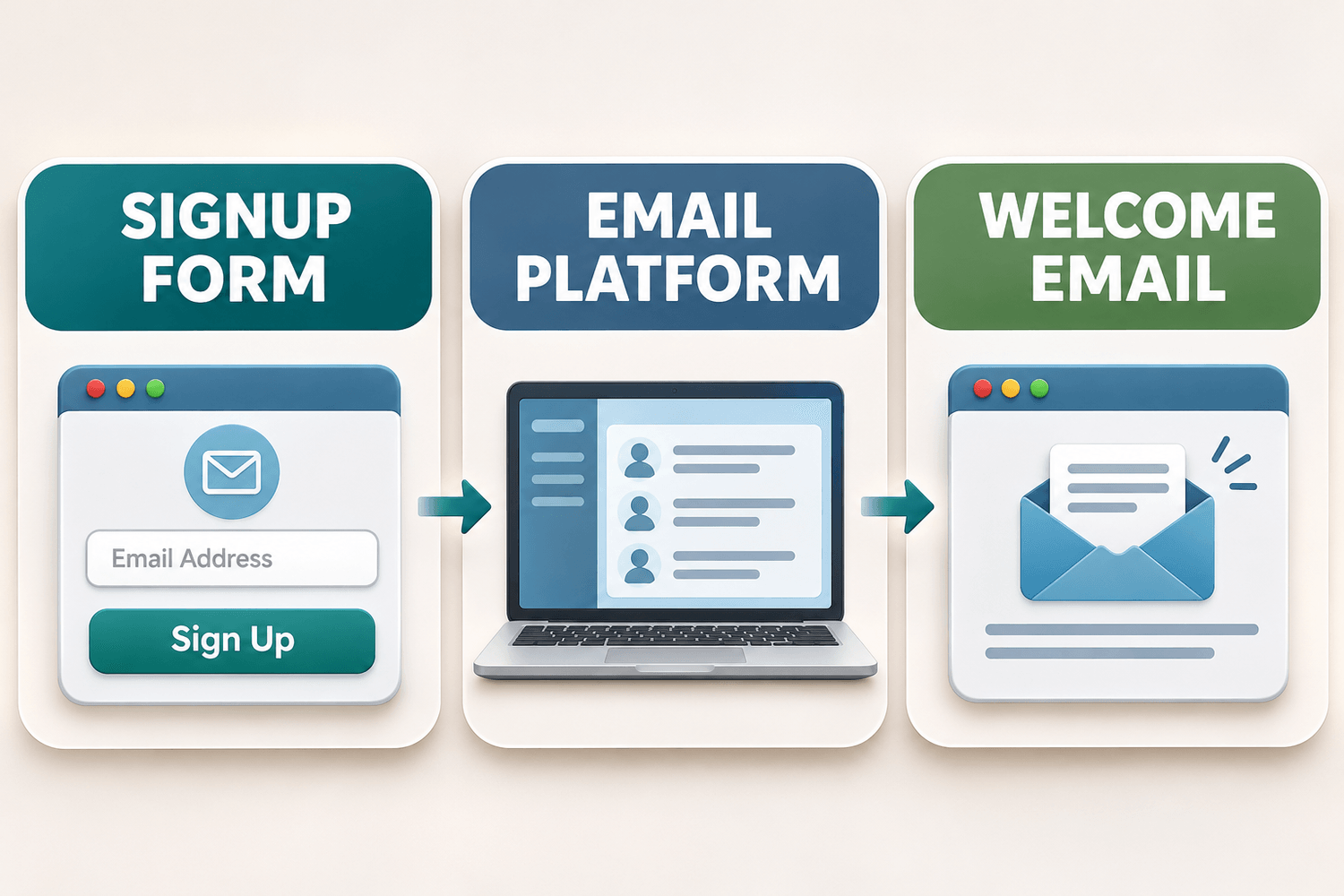
Check that the confirmation or welcome email arrives and that the promised resource is accessible.
If your platform uses an email confirmation step, explain that subscribers may need to confirm their address.
A simple, functional experience is more useful than an elaborate design that confuses visitors.
6. Build Trust With New Subscribers From the Beginning
Getting someone onto your email list is only the beginning.
Your next responsibility is to deliver what you promised and give subscribers a reason to remain interested.
Deliver What You Promised Immediately
If someone subscribes to receive a checklist, make that checklist available promptly.
Don't require them to navigate several unrelated promotional pages before accessing it.
Test the delivery process before promoting your signup offer.
If you're using a downloadable resource, check that the link works. If you're delivering an email lesson, make sure the first message is scheduled or sent as intended.
Meeting expectations is a simple way to establish credibility.
Send Helpful Follow-Up Emails
A welcome email doesn't have to be the last useful message someone receives.
You can follow up with explanations, practical examples, or answers to related questions.
For instance, after delivering a free traffic checklist, you might send an email explaining how to choose one traffic source to focus on.
Another email could discuss how to measure whether visitors are reaching the signup page.
This creates continuity between the original offer and your ongoing communication.
If you eventually recommend affiliate products or services, make sure the recommendations are relevant and any required disclosures are clear.
Set Realistic Expectations About Email Frequency
Tell subscribers what kinds of emails they can expect.
If you plan to send one educational email each week, explain that. If your schedule is less predictable, avoid promising a frequency you may not maintain.
Respect requests to unsubscribe.
For U.S. commercial emails, the FTC explains that applicable messages must include a valid postal address and an appropriate opt-out method. Opt-out requests generally must be honored within 10 business days.
Other privacy and marketing laws may apply depending on where your subscribers live.
Clear expectations and respectful email practices support a healthier long-term relationship.
7. Measure Your Progress and Improve Your Signup Process
Without basic measurement, it's difficult to know which activities deserve more attention.
You don't need advanced analytics to begin. A few simple numbers can help you understand what's happening.
Track Visitors and New Email Subscribers
Start by tracking how many people reach your content or signup page and how many new subscribers join.
Keep these measurements separate.
A page could receive substantial traffic but produce relatively few signups. Another page might receive less traffic but attract visitors who are more interested in its offer.
The number of visits alone doesn't tell you whether your list-building strategy is effective.
Also distinguish total visits from unique visitors when interpreting reports, and use the same measurement consistently.
Calculate Your Email Signup Rate
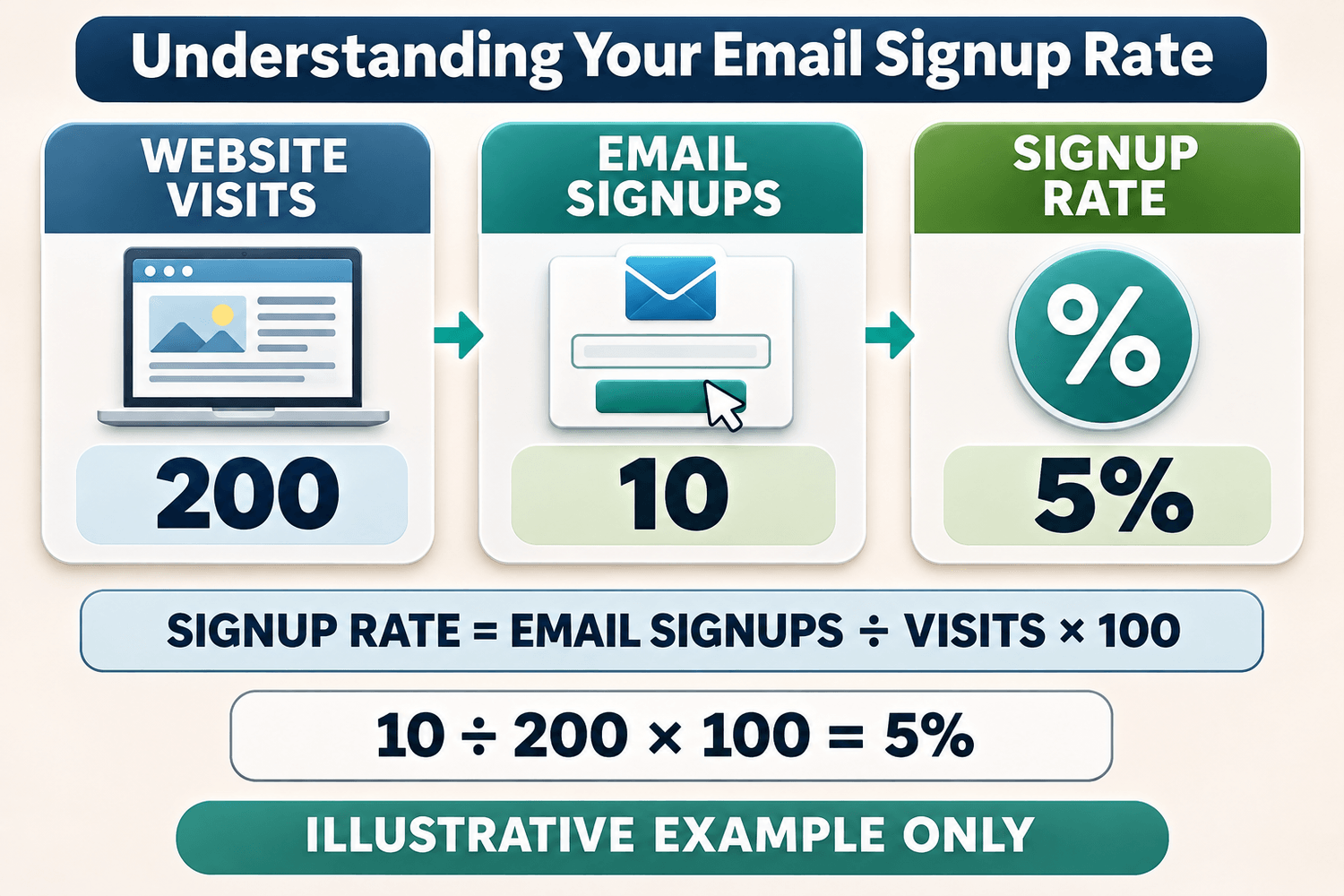
A signup rate expresses the relationship between signups and visits.
Use this formula:
Signup Rate = Email Signups ÷ Visits × 100
Here's a hypothetical example:
The calculation is:
10 ÷ 200 × 100 = 5%
This means 10 signups were recorded for every 200 measured visits in the example.
It does not mean a 5% signup rate is typical or guaranteed.
For useful comparisons, measure signups and visits for the same page, time period, and traffic scope. If one person subscribes after multiple visits, the visit-based rate is not the same as a unique-visitor conversion rate.