How to Get Traffic to a New Blog for Free: 9 Ways to Find Your First Readers

You started a blog, published a few articles, and waited for visitors to arrive. Maybe you shared a post on social media or checked your website statistics a few times.

But the traffic barely moved.

It's a frustrating experience, especially when you've spent hours creating content you believe could help people.

The good news is that you don't need paid advertising, thousands of followers, or expensive marketing software to start attracting readers.

Learning how to get traffic to a new blog for free begins with understanding two things: how people discover content and how you can make your articles easier to find.

Some methods focus on building long-term visibility through search engines. Others help introduce your content to people who might benefit from it right now.

In this guide, you'll discover nine realistic ways to promote your new blog, which methods deserve your attention first, and how to organize your efforts into a manageable 30-day plan.

Why Getting Traffic to a New Blog Is So Difficult

Why Publishing Blog Posts Doesn't Automatically Bring Visitors

Publishing an article makes it available online, but that doesn't mean people will immediately discover it.

Search engines must first discover and evaluate your pages. Even when an article appears in search results, it competes with other content answering similar questions.

A new blog may also have few external links, limited visibility, and no established audience to share its content.

That's why publishing consistently is only part of the process.

You also need to create articles people are searching for and help potential readers discover them.

The Difference Between Search Traffic and Referral Traffic

Not all blog visitors arrive the same way.

Organic search traffic comes from people discovering your articles through unpaid search results.

Referral traffic comes from links on other websites, such as a relevant blog or community discussion.

Visitors can also arrive through social media, email newsletters, or direct visits.

These sources serve different purposes.

Search traffic can help people discover older articles long after publication. Relevant referrals may introduce your content to interested readers before your blog develops much search visibility.

A balanced approach gives your new blog more than one opportunity to be discovered.

What New Bloggers Should Expect From Free Traffic Methods

Free traffic doesn't mean effortless traffic.

Instead of paying for advertising, you're investing time in researching topics, improving articles, participating in communities, and building relationships.

Some activities may introduce readers to your content relatively quickly. Others require sustained effort before meaningful results appear.

There isn't a universal timeline.

Your niche, competition, content quality, and promotional choices all influence what happens.

The goal is to build a repeatable process rather than expect every article to attract visitors immediately.

Start With These Three Free Traffic Foundations

Before promoting your articles, make sure your blog is prepared for visitors.

Make Sure Search Engines Can Discover Your Blog

Start with Google Search Console.

This free tool helps website owners monitor their visibility in Google Search and investigate indexing issues.

Check whether your important articles can be indexed, review any reported problems, and confirm that your website's navigation works properly.

You can also submit an XML sitemap if your website provides one.

A sitemap helps search engines discover URLs, particularly on newer websites with few external links. However, submitting one doesn't guarantee indexing or rankings.

Google explains these limitations in its crawling and indexing guidance.

You don't need to become a technical SEO expert. Start by making sure your important pages are accessible.

Publish Content That Answers Specific Reader Questions

Think about why someone would search for your article.

A broad topic such as "blogging" could mean dozens of things.

A specific question like "how to write your first blog post" reveals a clearer need.

Your content should answer that need directly.

Use descriptive headings, practical explanations, and examples that help readers take action.

Google's people-first content guidance emphasizes creating useful information for readers rather than content primarily designed to manipulate rankings.

Give Visitors a Reason to Explore More Than One Article

Imagine someone discovers your guide about choosing a blogging niche.

They might also benefit from articles explaining keyword research, content planning, or writing their first post.

Relevant internal links help readers continue learning.

Make your navigation understandable, use descriptive link text, and connect articles that naturally complement one another.

For example, if you're struggling with search visibility, this guide about why your blog posts aren't getting organic traffic explores related problems worth investigating.

The objective is to make useful information easier to find, not to insert links everywhere.

Nine Free Ways to Get Traffic to Your New Blog

Once those foundations are in place, you can begin promoting your content.

You don't need to implement all nine methods immediately. Choose the ones that best match your audience, available time, and existing articles.

1. Target Beginner-Friendly Long-Tail Keywords

Long-tail keywords are more specific search phrases that often reveal a clearer question or need.

For example, instead of targeting "email marketing," a new blogger might write about "how to start an email list without a website."

The second phrase suggests a particular reader and problem.

You can discover potential topics by examining search suggestions, related questions, and discussions in your niche.

Then investigate whether existing results answer those questions effectively.

Long-tail keywords aren't automatically easy to rank for. Some specific phrases are highly competitive.

Start here: Identify five specific questions your intended readers ask. Choose one you can answer thoroughly and accurately.

2. Improve Your Blog Posts for Search Intent

Search intent describes what someone hopes to accomplish when searching.

A person looking for "how to start a blog" probably wants instructions, not an unrelated product comparison.

If your article doesn't satisfy that expectation, attracting and retaining interested readers becomes harder.

Review your existing posts.

Ask whether each introduction explains the topic clearly, whether the headings reflect useful questions, and whether readers receive enough detail to act.

You don't necessarily need longer articles. You need articles that answer their intended questions well.

Start here: Choose one existing post and compare its coverage with the questions its intended readers are trying to answer.

3. Share Helpful Content on Relevant Social Platforms

Social media can help people discover your blog without waiting for search visibility to develop.

The important part is choosing platforms where your intended readers actually spend time.

For example, a business-focused blogger might find relevant conversations on LinkedIn, while a visual hobby blog might benefit from a different platform.

Instead of repeatedly posting article links, share something useful from the content.

Explain a mistake, offer a short tutorial, or answer a common question.

Then provide a relevant article link when appropriate.

Start here: Choose one social platform and create three useful posts based on an existing article.

4. Participate in Online Communities Without Spamming

Online communities can introduce your content to people interested in your topic.

But there's an important difference between contributing and promoting.

Joining a discussion solely to drop your blog link rarely creates meaningful relationships.

Instead, answer questions, offer useful explanations, and participate in conversations.

If someone asks a question your article answers in greater detail, a link may be appropriate when community rules allow it.

Some communities prohibit self-promotion entirely. Respect those restrictions.

Start here: Find two relevant communities and spend time understanding their discussions before sharing anything promotional.

5. Answer Relevant Questions Where Your Readers Spend Time

People ask questions in forums, discussion groups, and specialized online communities every day.

Those questions can reveal both content opportunities and potential readers.

Suppose your blog teaches beginner gardening.

You might discover someone asking why their tomato plants aren't growing.

Rather than replying with a generic link, explain possible causes and offer practical troubleshooting steps.

If you have a detailed article that genuinely adds value, mention it when permitted.

This approach helps establish relevance through useful participation.

Start here: Find three questions connected to your blog's subject and write thoughtful answers without expecting immediate visits.

6. Repurpose Blog Posts Into Short Educational Content

You don't need a completely new idea every time you promote your blog.

One helpful article can become several smaller pieces of content.

A beginner blogging guide might provide material for:

  • A short checklist.
  • A social media post explaining one mistake.
  • A simple educational graphic.
  • A brief question-and-answer post.

Each piece should provide value independently rather than merely advertise the original article.

Repurposing can make content promotion more manageable because the underlying research and explanations already exist.

It doesn't guarantee engagement, but it gives your existing work additional opportunities to reach interested people.

Start here: Select one article and turn its three most useful ideas into separate educational posts.

7. Connect Related Articles With Internal Links

Internal linking is another free method for helping readers discover more of your content.

Suppose someone visits an article about choosing a blog topic.

A natural link to your keyword research guide gives them a useful next step.

You can also revisit older articles and link to newer resources when they genuinely expand on the discussion.

Use descriptive anchor text so readers understand what they'll find.

Google's Search Essentials also recommends crawlable links that help search engines discover website pages.

Internal links won't guarantee better rankings, but they can improve navigation and content discovery.

Start here: Review five existing articles and identify relevant opportunities to connect them.

8. Collaborate With Other Bloggers in Your Niche

You don't need a large audience to begin building relationships with other content creators.

Look for bloggers covering complementary subjects.

For example, someone writing about beginner budgeting might collaborate with a blogger focused on affordable meal planning.

Possible collaborations include educational interviews, shared resources, or useful contributions to one another's content.

Focus on genuine reader value rather than exchanging links purely to influence search rankings.

Not every collaboration will generate visitors, and building relationships takes time.

Start here: Identify three relevant bloggers and look for an authentic opportunity to contribute something useful.

9. Build a Free Email List to Encourage Return Visits

Email marketing isn't only for established businesses.

A new blogger can begin collecting voluntary subscriptions from readers who want more helpful content.

You might offer a simple checklist, beginner guide, or occasional educational newsletter.

The key is giving visitors a clear reason to subscribe.

Use an email service with an appropriate free option, explain what subscribers will receive, and obtain proper consent.

Remember that collecting subscribers and generating website traffic are different activities.

An email list provides a way to notify interested readers when you publish something relevant. Whether they return depends on the value of your messages.

Start here: Create one useful signup opportunity connected to your blog's main topic.

Which Free Blog Traffic Methods Should You Focus On First?

Knowing nine methods is useful. Trying to master all of them simultaneously usually isn't.

Choose Methods Based on Your Time and Experience

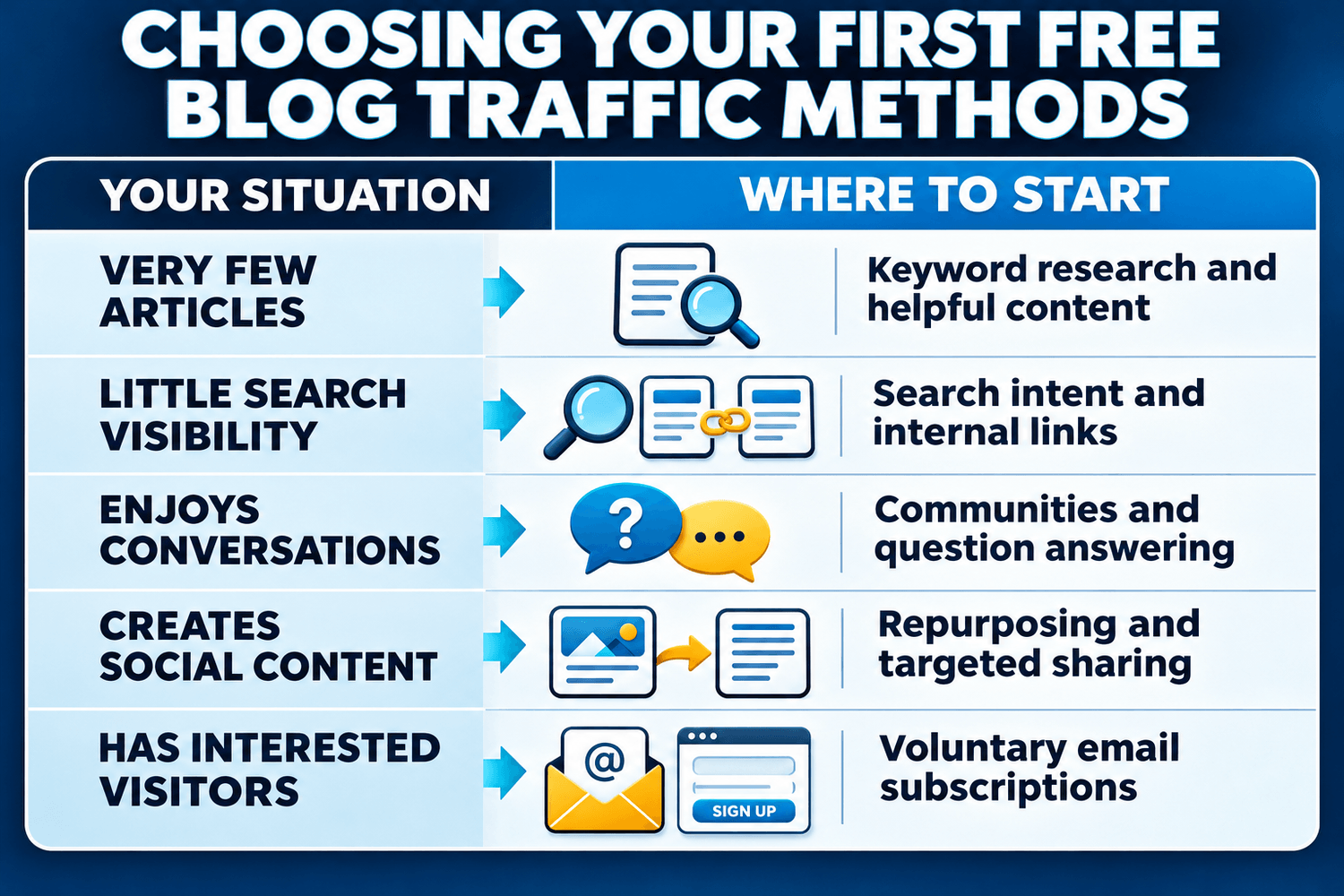
Your best starting method depends on your situation.

Your Situation Suggested Starting Method
You have very few articles Specific keyword research and useful content
You have articles but little search visibility Search-intent improvements and internal links
You enjoy conversations Relevant communities and question answering
You already create social content Repurposing and targeted sharing
You have occasional interested visitors Voluntary email subscriptions

These are practical starting suggestions, not guaranteed performance rankings.

Choose an approach you can maintain consistently.

Balance Long-Term Search Traffic With Short-Term Discovery

SEO and active promotion can complement each other.

Search-focused content gives your blog opportunities to appear when people look for relevant answers.

Community participation and social distribution give you ways to introduce that content directly to interested audiences.

For a beginner, a manageable combination might involve improving one search-focused article each week while participating regularly in one relevant community.

Neither method guarantees immediate results.

Together, however, they provide different paths through which readers may discover your work.

Avoid Trying Every Traffic Method at Once

Constantly switching platforms can make it difficult to understand what's working.

You might spend one week on social media, another in forums, and another researching completely different strategies.

Before long, you've started several activities without developing a consistent process.

Instead, choose one primary discovery method and one supporting method.

Give yourself enough time to complete meaningful actions and review the available evidence.

Adjust when your observations justify it, rather than changing direction every time traffic fluctuates.

A Simple 30-Day Plan to Start Promoting Your Blog

You don't need an elaborate marketing calendar.

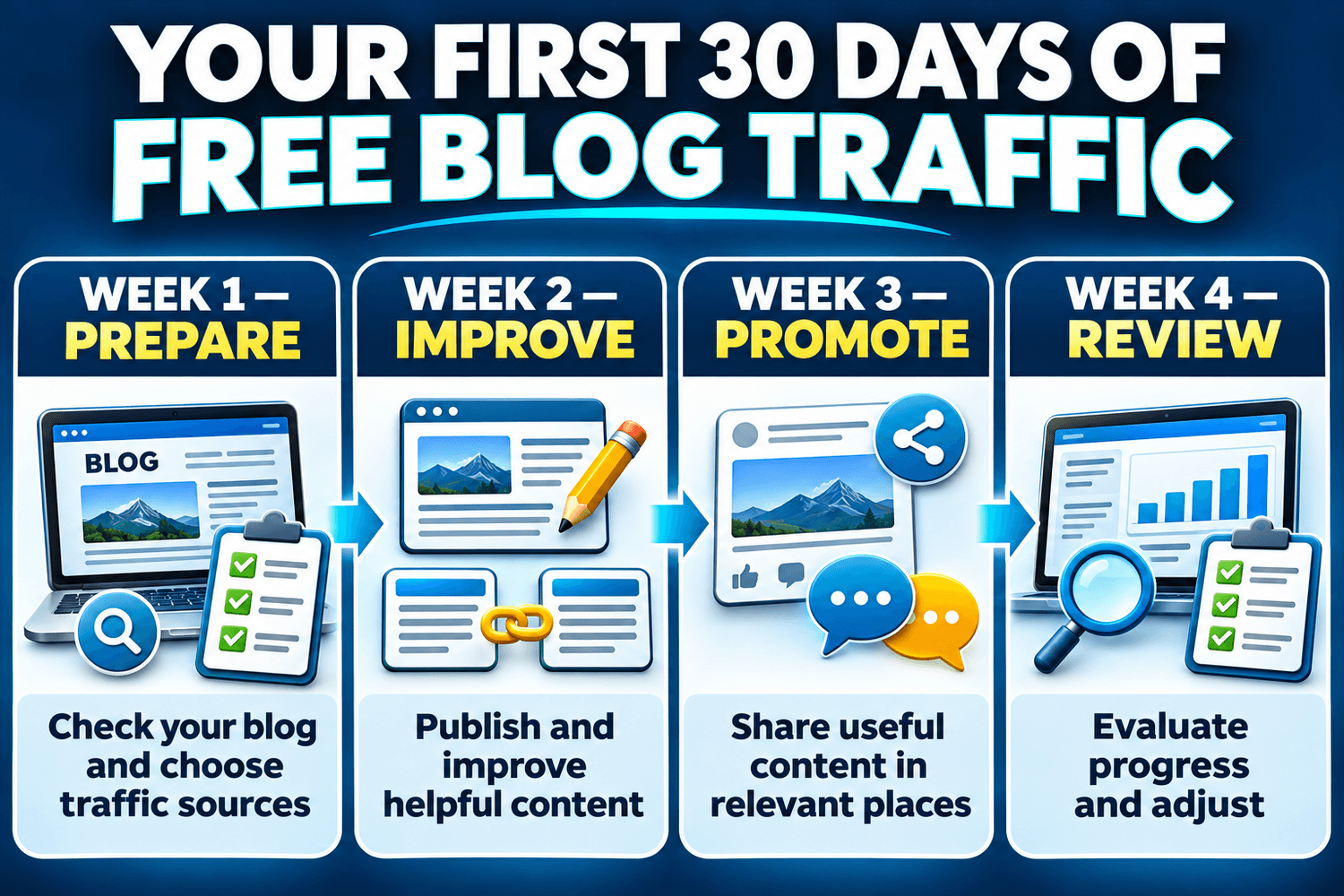
This four-week framework provides a starting point that you can adjust to your available time.

Week 1: Prepare Your Blog and Choose Your Traffic Sources

Begin by checking your website's basic discoverability.

Review Search Console, inspect your navigation, and identify your most useful existing articles.

Then choose one or two traffic methods that match your audience.

Write down what you intend to do each week.

Keep your initial commitments manageable.

Week 2: Publish and Improve Helpful Content

Choose a specific reader question and create an article that answers it thoroughly.

If you already have useful posts, improve one or two instead.

Review headings, examples, explanations, and relevant internal links.

Avoid publishing extra articles simply to increase your post count.

One genuinely useful resource can be a better investment of your time than several rushed articles.

Week 3: Promote Your Articles in Relevant Places

Begin sharing helpful information where your intended readers spend time.

You might publish educational social posts, answer relevant community questions, or contribute to a niche discussion.

Focus on usefulness rather than posting frequency alone.

Keep track of which activities you complete and where you share content.

Avoid repeating identical promotional messages across unrelated communities.

Week 4: Review Your Progress and Adjust Your Approach

Look at the information available in your website analytics and Search Console.

Search Console's performance reports can show impressions, clicks, and related search performance information.

Search Console Help

An impression indicates visibility in a Google surface under that report's counting rules; it isn't the same as a website visit.

Check which articles received attention, which search queries appeared, and whether any referral sources brought visitors.

If your numbers are small, don't automatically assume the strategy failed.

Review what you completed, identify what you learned, and decide which actions deserve another month.

The purpose of the first 30 days is to establish a useful process, not to promise a particular traffic milestone.

Common Mistakes That Keep New Blogs From Getting Traffic

Even helpful articles can struggle to attract readers when the surrounding strategy doesn't match the audience.

Publishing Without Understanding Search Intent

A common mistake is choosing topics without considering what readers actually want to know.

An article might contain plenty of information while failing to answer its intended question.

Before writing, identify the reader's problem and the outcome they expect.

Then organize your content around satisfying that need.

If you're updating an older article, look for missing explanations, confusing sections, and opportunities to make the information more useful.

Promoting Content to the Wrong Audience

More exposure doesn't automatically mean more interested readers.

Sharing a beginner gardening article in an unrelated business discussion might produce little meaningful engagement.

A smaller community focused on gardening could be more relevant.

Consider whether people in a particular space are likely to benefit from your content before sharing it.

Relevance matters more than simply distributing links as widely as possible.

Expecting Immediate Results From Organic Search

Organic search visibility can take time, and there is no guaranteed schedule.

Google explains that crawling and indexing depend on multiple factors and cannot be promised within a specific timeframe.

Google for Developers

Rather than checking rankings constantly, focus on improving your articles, maintaining a useful website, and understanding the information available in your reports.

If a page isn't indexed, investigate the reason.

If it's indexed but receives little visibility, review the topic, search intent, and usefulness of the content.

Make adjustments based on evidence rather than assuming every slow week requires a completely new strategy.

Frequently Asked Questions About Free Blog Traffic

Can You Get Traffic to a New Blog Without Spending Money?

Yes. Organic search, relevant community participation, social sharing, internal linking, and collaboration can all help readers discover a blog without purchasing advertising.

These methods still require time, effort, and useful content. None guarantees a particular number of visitors.

How Long Does It Take for a New Blog to Get Traffic?

There isn't a reliable universal timeline.

Results depend on factors such as competition, content relevance, website discoverability, and promotional activity.

Some referral visits may occur after relevant content is shared, while organic search visibility can develop at a different pace.

Focus on improving discoverability and evaluating actual progress rather than expecting results by a specific date.

Do You Need Social Media to Get Blog Traffic?

No. Social media is one possible discovery channel, not a requirement.

Blogs can attract visitors through search engines, relevant referrals, collaborations, and other sources.

Choose channels that match your audience and the time you can realistically commit.

How Often Should You Promote a New Blog Post?

Promote articles when you have something relevant and useful to contribute.

That might involve sharing a new educational example, answering a related question, or introducing the article to an appropriate audience.

Avoid repetitive link posting or treating every conversation as a promotional opportunity.

Start by choosing one article you can improve for discoverability and one relevant place where you can contribute something helpful this week.

Those two actions give you a practical foundation for finding your first readers.


Ready to Take Your Online Traffic Strategy Further?

Getting visitors to your blog is a great first step. But what happens after someone discovers your content?

Building an email list can help you turn interested visitors into subscribers you can stay connected with.

If you're looking for a beginner-friendly way to explore lead generation and email marketing without complicated technical skills, I've put together a free report to help you get started.

WRITTEN BY

Tom Kimpton

Founder, Marketing With Tom

Tom Kimpton is the founder of Marketing With Tom, where he shares practical strategies for affiliate marketing, traffic generation, email list building, and making money online. He focuses on testing tools and strategies firsthand and sharing what he learns to help beginners build their online business.

READY FOR THE NEXT STEP?

Build Your Traffic and Email List With the Tools I Use

I’ve put together the resources I use and recommend for generating

traffic, building an email list, and growing an online business.

If you’re looking for a simple place to start, this is it.

Practical strategies for building traffic, growing an email list, and creating an online marketing business.

Start Here

New to online marketing?

Start with practical guides for generating traffic, building your email list, and creating a simple marketing system.

© 2026 Marketing With Tom. All rights reserved.